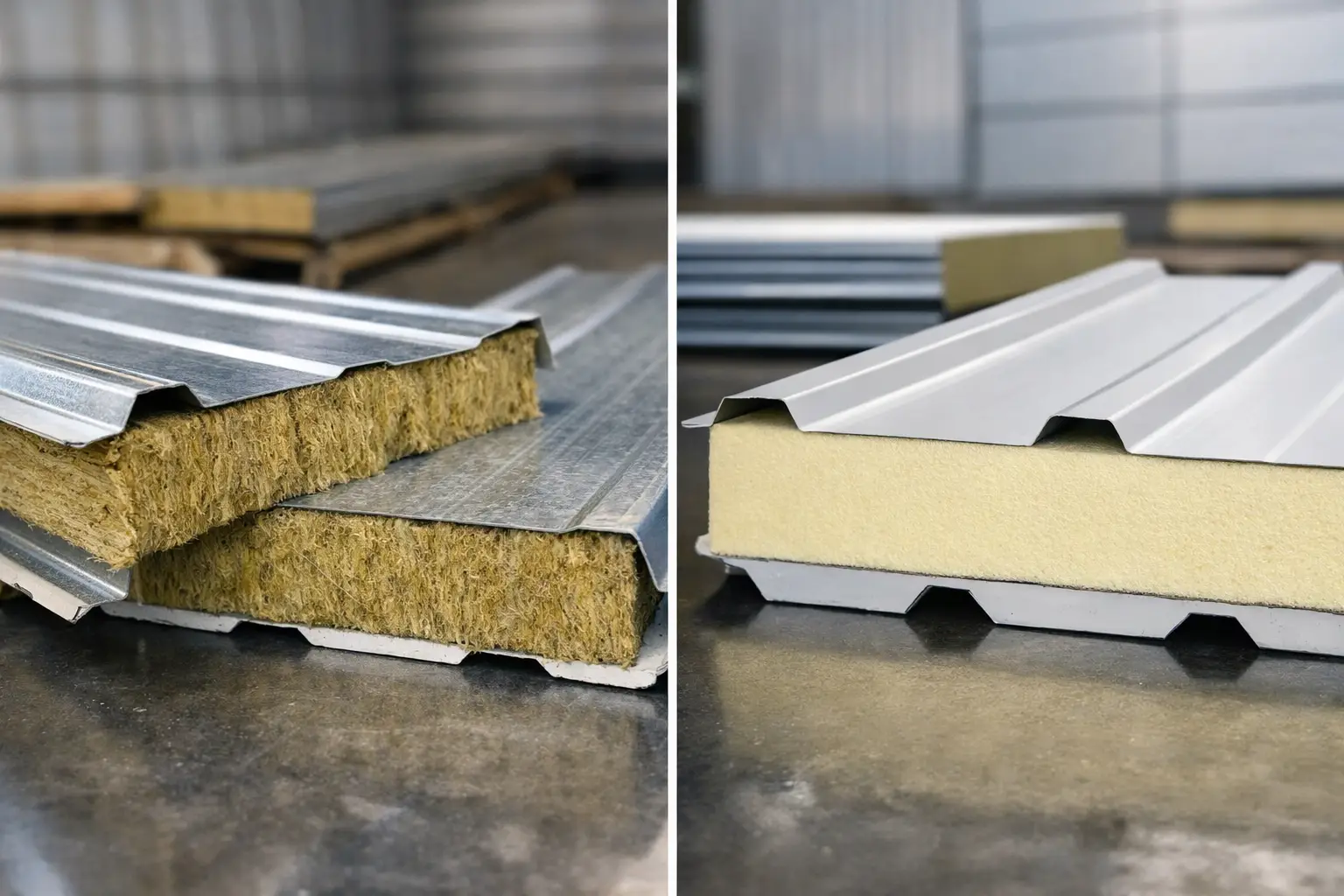
A warehouse roof, a factory wall, and a cold storage envelope may all use insulated sandwich panels, but they do not place the same demands on the panel core. The choice between Rockwool versus PIR sandwich panels affects thermal efficiency, fire strategy, sound control, panel thickness, project cost, and long-term operating performance. For contractors and procurement teams, the right answer comes from the building’s actual use, not from selecting one core material as universally better.
Rockwool versus PIR sandwich panels: the practical difference
Both products are composite building panels made with insulated cores bonded between pre-painted or coated steel facings. They provide a finished external skin, insulation layer, and internal lining in one installation system. The key difference is the insulation core.
Rockwool panels use a mineral wool core made from stone-based fibers. This material is widely selected where fire performance and acoustic control are leading design considerations. PIR panels use a polyisocyanurate foam core. PIR is valued for its strong thermal insulation performance at relatively low thicknesses, making it a common choice for temperature-controlled buildings, roofing, and wall cladding.
The facing material, coating quality, panel profile, joint design, thickness, fixing method, and supporting steelwork also affect the finished system. A core material should therefore be assessed as part of the complete panel specification rather than in isolation.
Thermal performance and panel thickness
For projects where controlling heat transfer is the primary objective, PIR panels are often the more efficient option. PIR foam generally provides a lower thermal conductivity than mineral wool, allowing a designer to achieve a target thermal value with a thinner panel in many applications.
That difference can matter in the UAE. High external temperatures, air-conditioned interiors, and rising energy expectations all place greater emphasis on the building envelope. A thinner PIR panel may help preserve internal space, reduce wall build-up, and simplify details around openings and flashings. It can be particularly practical for warehouses, prefabricated buildings, roof systems, and cold room applications where thermal continuity is a major requirement.
Rockwool panels can also provide effective insulation, but they commonly need greater thickness to reach a similar thermal target. This is not automatically a disadvantage. Where wall depth is available and fire or acoustic requirements carry more weight, the additional thickness may be justified.
Thermal performance should be checked using the required overall U-value for the roof or wall assembly. Do not compare panels by thickness alone. Joint details, thermal bridging through fasteners, roof penetrations, and installation quality can all influence real-world results.
Fire performance requires a system-level view
Fire behavior is often the deciding factor in Rockwool versus PIR sandwich panels, especially for industrial facilities, factories, commercial developments, and projects with insurer or authority requirements.
Mineral wool is non-combustible by nature and is commonly specified where a higher level of fire resistance is needed within the wall or roof envelope. Its structure remains stable at high temperatures, which makes it suitable for applications where the design brief places strong emphasis on compartmentation and fire separation.
PIR is a fire-retardant foam insulation material, but it is not the same as a mineral wool core. PIR can form a char layer when exposed to heat, helping slow flame spread under certain conditions. However, its fire classification and suitability must always be evaluated against the specific panel system, panel thickness, joint configuration, facing material, installation method, and project approval requirements.
A panel core’s classification should never be treated as a complete fire design. Openings, service penetrations, junctions, sealants, closures, and fire-stopping details must be coordinated carefully. Procurement teams should request the relevant product documentation for the proposed system and confirm requirements with the project consultant, civil defense authority, and insurer where applicable.
Acoustic control and internal comfort
Rockwool panels generally offer an advantage where sound absorption and noise reduction are important. The fibrous mineral wool core can help manage sound within factories, generator enclosures, workshops, plant rooms, and buildings located close to busy industrial activity.
PIR panels provide useful insulation and a clean internal finish, but their foam core is not usually selected primarily for acoustic absorption. If a project needs both efficient thermal control and improved acoustic performance, the wall or roof build-up may require additional acoustic measures rather than relying on the sandwich panel alone.
For a standard warehouse with limited internal noise concerns, this difference may have little impact on the final selection. For production facilities or spaces with sensitive office areas adjacent to operations, it should be considered early.
Moisture, condensation, and UAE operating conditions
Moisture control is not only a cold-storage issue. Condensation can occur whenever a large temperature difference exists between the interior and exterior, particularly around poorly sealed joints, roof penetrations, or air-conditioned spaces with high humidity loads.
PIR panels are frequently used for cold rooms and cold stores because they provide high thermal efficiency and can support a tightly insulated envelope when installed with correctly designed joints, sealants, and accessories. For these projects, panel selection must include vapor control, joint sealing, floor-wall interfaces, door details, and the requirements of the refrigeration design.
Rockwool panels need proper protection from water ingress. While the steel facings and sealed joints form part of that protection, prolonged exposure to moisture can affect the insulation’s performance. This does not rule out Rockwool for external walls or roofs. It means the panel system, detailing, drainage, and installation quality need close attention.
For either core type, a reliable installation is essential. Damaged facings, incomplete sealant lines, poorly finished flashings, and unprotected cut edges can create problems that no insulation core can fully correct.
Which panel fits common project types?
PIR panels are often a practical fit for general industrial roofs and walls, warehouses, workshops, prefabricated units, commercial buildings, and temperature-controlled facilities where thermal performance and controlled panel thickness are priorities. They can help create efficient, clean-lined building envelopes with fewer construction layers.
Rockwool panels are often considered for factory walls, plant rooms, fire-sensitive zones, partition walls, and projects where fire resistance or acoustic performance is a central requirement. They may also suit buildings where the specification calls for a non-combustible insulation core.
Some developments may use both. A project could specify PIR panels across general roof and wall areas while using Rockwool panels at designated fire-rated separations or noise-sensitive locations. The consultant’s drawings, authority requirements, and operating needs should guide that decision.
Looking beyond the purchase price
The panel with the lower initial rate is not always the lower-cost project solution. PIR can reduce insulation thickness for a given thermal objective, which may benefit detailing and usable internal dimensions. Rockwool may carry a different material cost but offer value where it helps satisfy fire or acoustic requirements without adding separate layers to the envelope.
Compare quotations on an equal basis: panel thickness, steel facing thickness, coating type, panel length, joint profile, required accessories, flashings, fasteners, sealants, and delivery scope. A low panel price can become less competitive if essential closure items, trims, or technical requirements are excluded.
Before placing an order, a clear specification should confirm:
- The required thermal value and the target panel thickness.
- The required fire performance and applicable authority or consultant requirements.
- Whether the building has acoustic, cold-storage, humidity, or hygiene-related needs.
- Steel facing thicknesses, coating requirements, panel profile, and color selection.
- Panel lengths, support spacing, fixing details, flashings, gutters, and accessories.
MetalSpan supports UAE contractors, fabricators, and project teams with PIR and fire-retardant sandwich panel options, together with the related roofing, cladding, and finishing accessories needed for a coordinated supply package.
A sound panel decision starts with the building’s operating conditions and specification priorities. When thermal efficiency, fire requirements, sound control, and installation details are reviewed together, the selected system is more likely to serve the project reliably over the long term.