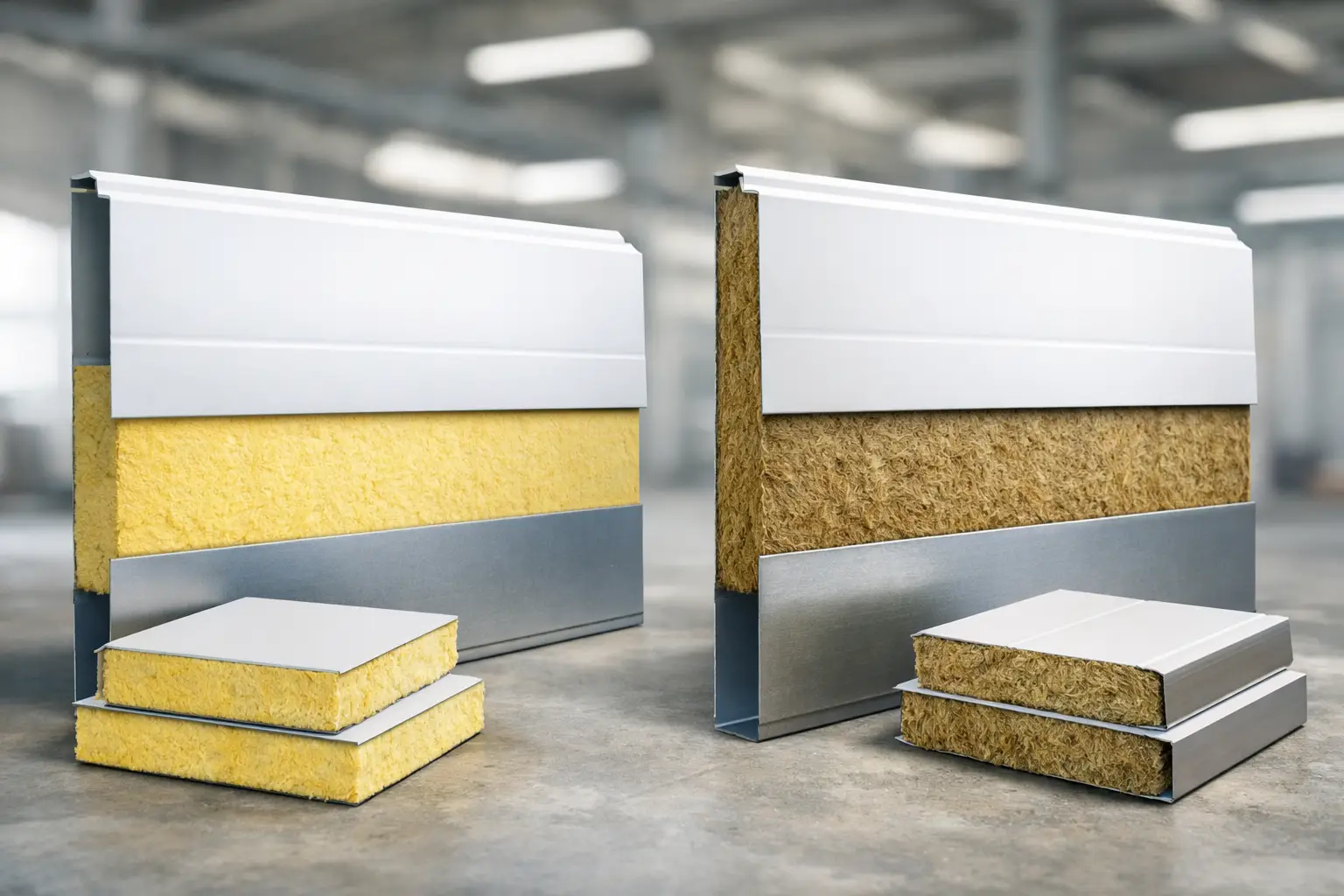
A warehouse roof in the UAE is not just a cover. It is part of the building’s thermal envelope, fire strategy, operating cost, and construction schedule. That is why the choice between PU versus Rockwool panels should begin with the project’s actual priorities, not simply the initial panel price.
Both panel types are widely used for industrial buildings, warehouses, factories, commercial facilities, prefab structures, and specialized enclosures. Each has clear strengths. PU insulated sandwich panels are commonly selected where thermal efficiency and lighter-weight construction are central requirements. Rockwool panels are often specified where a non-combustible mineral-wool core and acoustic performance are major considerations.
The right answer depends on the building use, local authority requirements, roof or wall design, insulation target, fire strategy, structural support layout, and the performance required over the life of the project.
PU versus Rockwool panels: the core difference
A sandwich panel combines two metal facings with an insulated core. The core material is what creates the main difference in thermal, fire, acoustic, and handling characteristics.
PU panels use a rigid polyurethane foam core. This material is valued for its strong insulation performance relative to its thickness. For projects where internal temperature control matters, PU panels can help designers achieve the required thermal resistance without using excessively thick wall or roof assemblies.
Rockwool panels use a stone-wool or mineral-wool core made from inorganic fibers. Their principal advantage is their reaction-to-fire behavior as part of an appropriately designed and tested panel system. The fibrous core also provides useful sound absorption characteristics, which can be relevant around machinery, workshops, and facilities near occupied areas.
Neither core is automatically better for every application. A cold store, for example, has a different priority set from a manufacturing facility, while a warehouse with fire-sensitive operations may require a different specification from a simple storage shed.
Thermal performance and energy control
In hot climates, heat gain through roofs and walls can place a continuous load on air-conditioning systems. Insulation selection therefore has a direct effect on comfort, operating conditions, and energy planning.
PU generally provides higher thermal insulation per inch of core thickness than Rockwool. This makes it a practical option where low heat transfer is the leading requirement, particularly for temperature-controlled spaces, cold rooms, cold storage areas, and buildings with limited room for thicker wall or roof assemblies.
For a warehouse or factory that only needs moderate internal temperature control, Rockwool may still be suitable when the panel thickness is selected correctly. The key point is to compare the stated thermal performance of the complete proposed panel, not just the core name. Panel thickness, metal facing profile, joint design, installation quality, and thermal bridging at fasteners and flashings all affect the finished envelope.
For cold room and cold store work, thermal continuity deserves special attention. Joints, floor-to-wall connections, door openings, and penetrations must be detailed carefully. A high-performing panel can still underperform if warm air can bypass the insulation through poorly sealed connections.
Thickness should follow the application
Selecting a panel only by choosing “PU” or “Rockwool” is incomplete. A roof exposed to direct sun, a conditioned office within a warehouse, and a freezer enclosure will need different thermal targets. Engineers and project managers should define the required insulation value first, then review which panel core and thickness meet it efficiently.
Fire considerations require a system view
Fire performance is often the deciding factor in the PU versus Rockwool panels discussion. Rockwool-core panels are commonly chosen for projects with stringent fire-related requirements because the mineral-wool core is non-combustible. This can make them a suitable consideration for industrial facilities, compartment walls, and buildings where the project fire strategy calls for this type of construction.
However, fire compliance should never be decided by core material alone. The performance of a wall or roof assembly depends on the full panel specification, thickness, metal facings, joint arrangement, fixing method, supporting structure, openings, penetrations, and the relevant test evidence or approval required for the project.
PU-core panels may be appropriate for many building uses when they meet the project specification and applicable authority requirements. But they should be reviewed carefully within the full fire design, especially where the building use involves high occupancy, sensitive operations, hazardous materials, or strict insurance and authority conditions.
The practical approach is straightforward: confirm fire requirements early, obtain the required technical documents from the supplier, and ensure the selected panel system matches the approved design. Changing core type after drawings, approvals, or procurement are underway can affect cost and schedule.
Weight, handling, and installation planning
PU panels are generally lighter than Rockwool panels of comparable dimensions. This can make transport, lifting, and installation more efficient, particularly on large roof areas or projects with limited crane capacity. Lower panel weight may also influence the design of secondary steelwork, although structural design must always be confirmed by the responsible engineer.
Rockwool panels are denser and heavier. This does not make them unsuitable for roofing or wall cladding, but it does require practical planning for handling, lifting equipment, installation crews, and support spacing. Longer panel lengths, windy site conditions, and elevated installation work all need to be considered during method planning.
For contractors, the best procurement decision is one that aligns panel size and weight with site realities. Confirm maximum available panel lengths, delivery access, unloading arrangements, storage conditions, and installation sequence before materials arrive. Good planning helps protect panel finishes, joints, and edges from damage.
Acoustic performance for industrial spaces
Noise is not always the first concern on a cladding package, but it can matter in workshops, generator enclosures, production areas, and buildings close to offices or residential zones. Rockwool’s fibrous structure can offer better sound absorption than a rigid PU foam core.
That said, acoustic results depend on the complete wall or roof construction. Openings, gaps at joints, service penetrations, doors, glazing, and internal finishes can have a major effect on how sound travels. If noise control is a key project requirement, the consultant should define the target acoustic performance rather than selecting a panel based only on general expectations.
Cost should be measured beyond the panel rate
Initial material cost matters, especially on large industrial developments. Yet the lowest panel rate does not always produce the lowest installed or operating cost.
PU panels may offer value where high thermal performance allows a thinner panel or supports lower cooling demand. Their lighter weight can also support efficient handling and installation. Rockwool panels can represent the more appropriate investment where fire-related requirements, acoustic priorities, or project specifications call for a mineral-wool core.
A meaningful comparison should include panel thickness, steel facing thickness, coating type, flashings, accessories, fasteners, sealants, transport, installation requirements, and expected operating conditions. For roofing and cladding packages, overlooked accessories can affect weather resistance and long-term appearance as much as the panel itself.
Choosing panels by building type
For cold rooms, refrigerated spaces, and buildings where insulation efficiency is central, PU panels are often a strong starting point because of their thermal performance. The final selection should account for internal temperature, humidity, vapor control, hygienic requirements, and joint sealing details.
For warehouses, factories, and commercial buildings, either core may be suitable. The choice often comes down to authority requirements, fire strategy, energy targets, acoustic needs, structural design, and budget. A standard warehouse with air-conditioned offices may even use different panel solutions in different areas of the same development.
For prefab houses, portacabins, and site facilities, panel weight, ease of installation, interior comfort, and fire requirements should be assessed together. For industrial partitions or fire-sensitive areas, Rockwool panels may be considered where the specified system requires a mineral-wool core.
Questions to settle before requesting a quotation
A clear inquiry helps suppliers provide a more accurate and useful proposal. Include the application, whether panels are for roof or wall use, required dimensions, preferred color and coating, insulation thickness, estimated quantity, project location, and expected delivery schedule.
It is also useful to state whether the project has consultant-approved drawings, fire-related requirements, thermal targets, or special conditions such as cold storage, high humidity, chemical exposure, or coastal installation. These details can affect the appropriate panel profile, coating selection, accessories, and fixing arrangement.
MetalSpan Trading supports contractors, fabricators, and project teams with PU and PIR insulated panels, fire-retardant panel options, cold store panels, roofing sheets, flashings, gutters, and related steel building materials across the UAE. A coordinated material package can simplify procurement and help keep the roof and wall system aligned from panel to finishing accessory.
The best panel decision is the one that fits the approved design and the building’s daily use. Define the performance requirement first, compare complete panel systems on the same basis, and involve the supplier before the order is finalized. That approach gives your project a clearer path from specification to dependable installation.