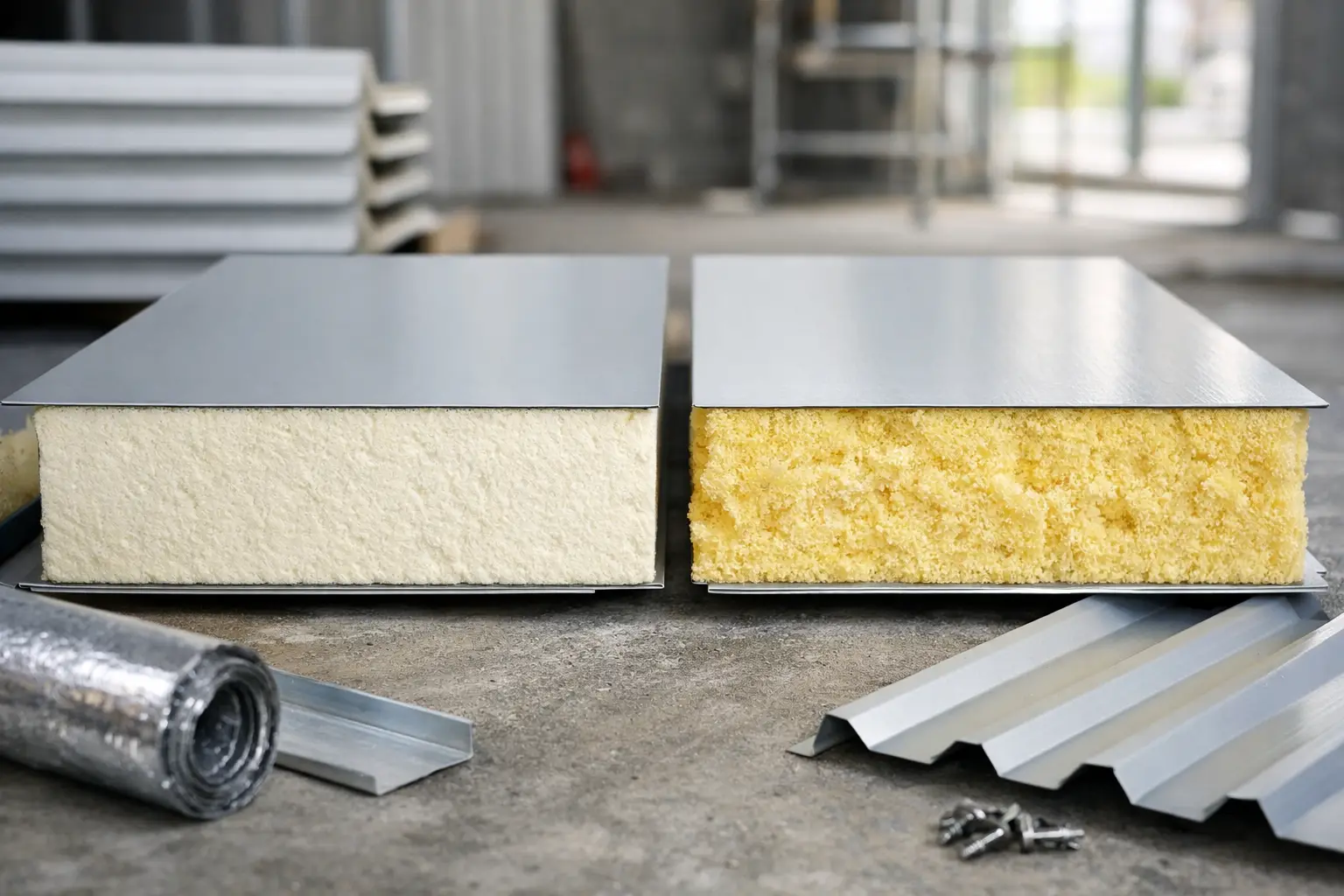
A warehouse roof, factory wall, or cold room enclosure can look similar from the outside while performing very differently over years of heat exposure and daily operation. When comparing PIR versus PU insulation panels, the right choice is not simply a matter of selecting the panel with the lowest initial price. It depends on the building’s thermal target, fire requirements, panel thickness, project use, and the tested system specified for the job.
Both PIR and PU insulated sandwich panels are widely used for roofing, wall cladding, industrial buildings, prefab units, warehouses, and temperature-controlled facilities. They combine metal facings with an insulating foam core, providing a practical single-panel solution for enclosure and insulation. Their differences become most relevant when the project team weighs fire performance, thermal efficiency, budget, and compliance requirements.
PIR versus PU Insulation Panels: The Core Difference
PU stands for polyurethane. PIR stands for polyisocyanurate, a related foam insulation material with a modified chemical structure. Both are closed-cell foam cores and can provide strong thermal insulation at relatively low panel thicknesses compared with many conventional insulation options.
The key distinction is how the foam reacts under elevated temperatures. PIR is formulated with a higher proportion of isocyanurate structures, which can form a more stable char layer when exposed to heat. This generally gives PIR an advantage in fire-related performance compared with standard PU foam. However, neither core should be described as universally fireproof. Fire performance depends on the complete tested panel assembly, including steel facings, core formulation, panel thickness, joint design, installation method, penetrations, and the applicable project standard.
For contractors and procurement teams, this means the panel core name alone is not enough for approval. The required test reports, certifications, and specification details should be reviewed against the project’s authority, consultant, insurer, and building-use requirements.
Thermal Performance for UAE Building Envelopes
Summer heat places a significant load on roofs and exterior walls across the UAE. A well-selected insulated panel helps reduce heat transfer through the building envelope, supporting a more stable internal temperature and reducing demand on cooling systems.
Both PU and PIR panels offer low thermal conductivity values, but actual thermal performance varies by product. Core density, panel thickness, metal facing profile, joint arrangement, aging characteristics, and manufacturing quality all affect the declared U-value or R-value. A thicker panel does not automatically make sense in every application, but it usually reduces heat flow more effectively than a thinner version of the same panel type.
PIR panels may provide slightly better thermal performance per thickness in some product ranges. That difference can matter where roof height, wall build-up, or cold room dimensions are tightly controlled. In many warehouse, workshop, and commercial applications, however, a correctly specified PU panel can also meet the thermal requirement at a competitive project cost.
The practical question is not whether PIR or PU is always better. It is whether the selected panel thickness and tested thermal value meet the design requirement for that particular roof, wall, partition, or cold storage enclosure.
Roof panels require careful specification
Roofing receives direct solar exposure and is often the largest heat-gain surface in an industrial building. For this reason, roof panel selection should account for panel thickness, roof profile, joint sealing, roof slope, fastener arrangement, skylight details, and flashing interfaces. Even a high-performing insulation core can lose its benefit when joints and penetrations are poorly detailed.
For warehouses and factories, a practical roof specification balances thermal needs with structural span, drainage, installation speed, and maintenance access. PIR may be preferred where fire-related requirements or higher thermal efficiency influence the specification. PU may be appropriate where the required insulation level is achieved and budget discipline is a primary concern.
Cold rooms and cold stores have different priorities
In cold storage projects, insulation continuity and vapor control deserve special attention. The panel system must help maintain the required internal temperature while limiting condensation risks at joints and connections. Thickness selection is especially important because chilled, frozen, and controlled-temperature rooms operate under conditions very different from a standard warehouse.
PIR and PU panels can both be used in temperature-controlled applications when selected for the intended service conditions. The project team should confirm the panel’s insulation properties, joint configuration, facing suitability, floor-to-wall details, and compatibility with doors, flashings, and accessories. A low purchase price is less valuable if incomplete detailing creates air leakage, thermal bridging, or difficult maintenance later.
Fire Considerations: Look Beyond the Core Name
PIR is often selected because it typically performs more favorably than PU in certain fire tests and high-temperature exposure conditions. This can make it a suitable option for projects where the specification places greater emphasis on fire behavior. Still, a PIR label does not replace a project-specific review of compliance documentation.
Fire performance terminology can be confusing because it may refer to reaction to fire, fire resistance, smoke development, combustible content, or the performance of a complete wall or roof system. These are not interchangeable. A panel that meets one test classification may not satisfy every requirement set by a consultant, civil defense authority, insurer, or international project standard.
Before ordering, request the available technical data for the exact panel being quoted. Confirm that it matches the required core type, thickness, facing, profile, and intended application. Changes in any of these details can affect the performance basis of the supplied panel.
Cost, Availability, and Whole-Project Value
PU panels are often selected for projects that need effective insulation and economical procurement. Depending on the required specification and market availability, they may offer a lower initial material cost than PIR alternatives. This can make PU a sensible choice for many standard industrial, commercial, and prefab building applications.
PIR panels may carry a higher purchase cost, particularly where specific fire-performance documentation or enhanced thermal requirements are involved. The additional cost can be justified when it aligns with the project specification, insurance expectations, or long-term energy objectives. It is not automatically justified for every building.
Procurement should also consider panel length availability, coating requirements, accessories, delivery sequencing, and installation coordination. A panel that is technically suitable but arrives without compatible flashings, sealants, closures, and fixing details can create delays and site modifications. Treat the roof or wall as a complete system rather than as a collection of separate materials.
How to Choose Between PIR and PU Panels
Start with the project documents. If the consultant has specified a PIR core, a particular fire classification, or a tested assembly requirement, the quotation should follow that requirement without substitutions unless formally approved. For design-and-build or contractor-led decisions, establish the building use and performance priorities before comparing prices.
A PIR panel is commonly the stronger option when fire-related criteria are a key part of the specification, when thermal performance must be maximized within a limited thickness, or when the project requires supporting documentation for a defined panel system. A PU panel can be a practical option when the building’s thermal target is clear, the required fire criteria are met by the proposed system, and cost efficiency is central to the decision.
Also consider the environment around the panel. Coastal exposure, industrial locations, humidity, chemical exposure, and frequent washdown may influence the choice of metal coating and facing more than the insulation core itself. For roofing, wind load and fixing layout matter. For walls, impact exposure, openings, and connection details matter. For cold rooms, joint sealing and vapor control matter.
Questions to Confirm Before Requesting a Quote
A clear request for quotation reduces the risk of receiving panels that are difficult to compare. Provide the panel application, required length and thickness, roof or wall profile, facing color and coating preference, estimated quantity, project location, and expected delivery schedule. If the project has fire, thermal, or authority requirements, include those at the start.
It is also useful to ask whether the quoted price includes essential accessories such as flashings, ridge caps, gutters, fasteners, sealants, foam closures, and joint materials. These items affect weather tightness, appearance, installation efficiency, and the final project budget.
MetalSpan Trading supports contractors, fabricators, and project teams with PIR and PU insulated sandwich panel options suited to roofing, wall cladding, warehouses, prefab structures, and cold storage applications across the UAE. The most reliable selection begins with a clear scope, verified technical requirements, and materials that work together as one complete enclosure system.
Choose the panel core after defining what the building must achieve, then confirm the supporting details before materials reach the site. That approach protects both the project schedule and the long-term performance of the building envelope.