A channel that looks suitable on a drawing can create problems at fabrication stage if its actual depth, flange width, thickness, or weight differs from the requirement. For contractors and procurement teams, understanding mild steel channel sizes helps prevent incorrect orders, unsuitable connections, and avoidable delays when steel reaches site.
Mild steel channels are widely used for secondary framing, supports, bracing arrangements, equipment bases, fabricated frames, and building components. The right section is not simply the largest one available. It must suit the intended load, span, connection detail, fabrication method, and project specification.
Understanding Mild Steel Channel Sizes
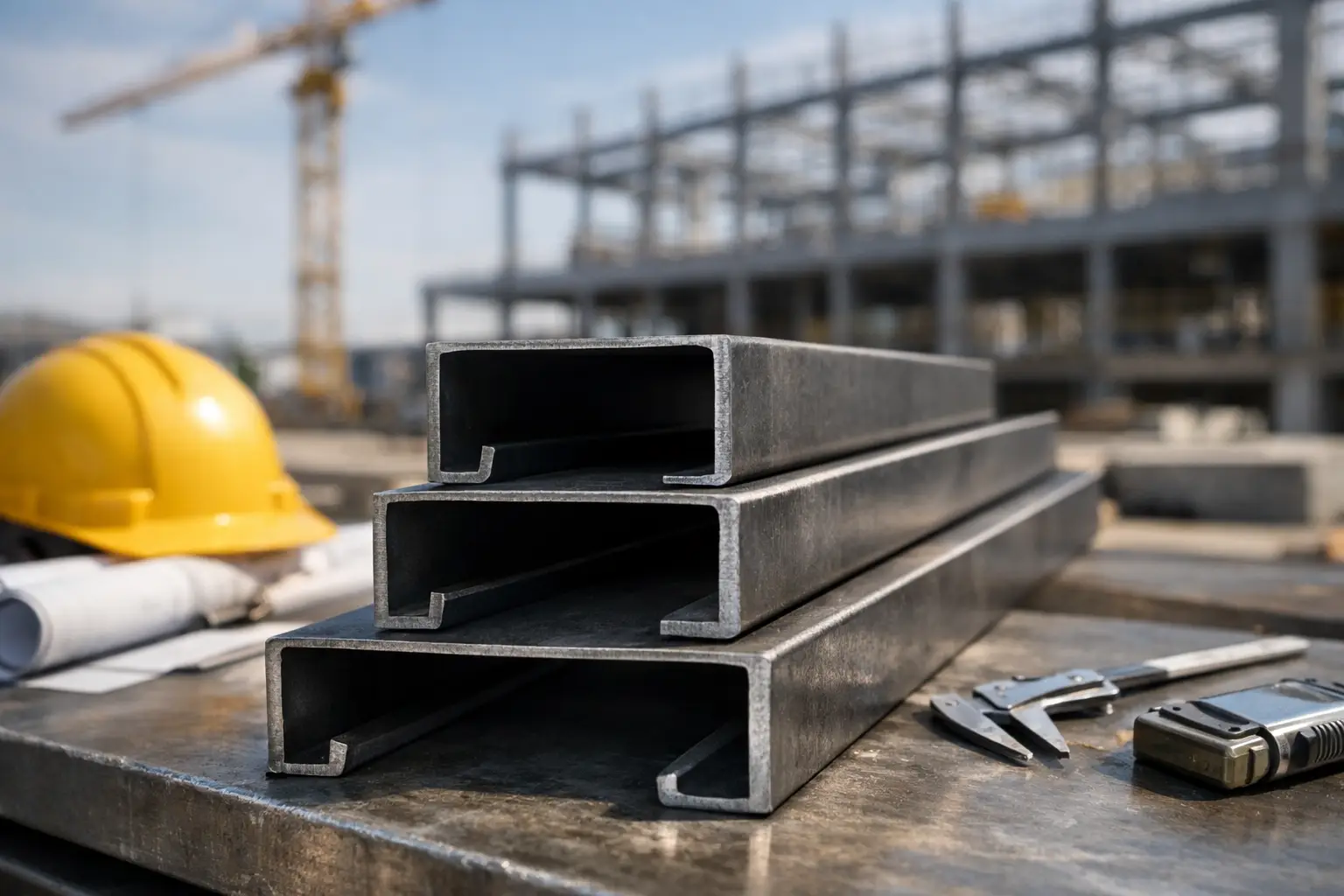
A mild steel channel is a section with one web and two parallel or tapered flanges, creating a C-shaped profile. Size descriptions usually refer to the overall depth, flange width, web thickness, flange thickness, and section weight per meter. Depending on the supplier, the designation may also follow a recognized structural-section standard.
For example, a channel may be described by its nominal depth and flange width, followed by material thickness or unit weight. However, this format is not identical across all product ranges. A 100 mm channel from one range may not have the same flange profile or weight as another 100 mm channel. This is why a size reference alone is not always enough for purchasing.
The dimensions that matter most are:
- Depth: the overall height of the channel, measured across the web.
- Flange width: the horizontal width of each side flange.
- Web and flange thickness: dimensions that influence the section's strength, connection options, and weight.
- Weight per meter: a practical figure for estimating steel quantity, handling requirements, transport, and cost.
For fabricated work, also confirm the inside radius at the web-to-flange junction, straightness, length tolerance, and surface condition where relevant. These details can affect fit-up, welding access, and the placement of bolts or plates.
Common Channel Size Ranges and Uses
Channel sections are commonly available in small, medium, and heavy profiles. The exact range available depends on the section type, supply standard, and required quantity. Smaller channels may suit light frames, supports, trims, and fabricated brackets. Medium sections are often selected for secondary structural members, equipment platforms, and warehouse support work. Larger, heavier channels may be specified for built-up frames, lintels, columns, and industrial support arrangements where an engineer has defined the loading criteria.
The following guide shows how channel proportions generally affect application decisions:
| Channel characteristic | Typical practical effect | |---|---| | Greater depth | Can improve resistance to bending when the load acts in the appropriate direction | | Wider flanges | Provides more area for connections and can improve stability in certain arrangements | | Increased thickness | Adds section weight and may improve resistance to local bending or connection stresses | | Higher kg/m weight | Usually indicates more steel in the section, but does not replace structural design verification |
A deeper channel is not automatically the better choice. If a member must connect to a narrow support, fit within a wall or roof build-up, or accept a specific bolt arrangement, flange width and thickness may matter as much as overall depth. Procurement should follow the approved drawing, bill of quantities, or engineer's section schedule rather than a visual comparison.
Hot-Rolled Channels and Cold-Formed C Sections
This distinction is particularly important in construction purchasing. Hot-rolled structural channels are generally heavier sections formed at high temperature and used where a specified structural steel profile is required. Cold-formed C sections are produced from sheet steel and are commonly used for lighter framing and purlin applications.
They may both be called “channels” on site, but they are not interchangeable. Their material thicknesses, geometry, connection behavior, and intended use can differ significantly. A cold-formed C purlin should not be substituted for a hot-rolled channel unless the project engineer has reviewed and approved the change.
For roofing and wall-cladding projects, C and Z purlins are often selected as secondary members supporting profiled sheets or insulated sandwich panels. Purlin selection should consider panel span, support spacing, wind actions, roof slope, fastener locations, openings, and the complete building design. The purlin depth is only one part of that decision.
How to Select the Right Channel Size
Start with the function of the member. Is the channel acting as a non-load-bearing frame component, a support rail, a purlin, a beam, or part of a fabricated assembly? The answer determines whether the primary concern is bending, compression, local connection strength, deflection, or a combination of these factors.
Next, review the span and support conditions. A channel spanning between two points behaves differently from one fixed into a frame or supported at several intermediate locations. Load direction also matters. Channels can twist more readily than symmetrical sections in some applications, especially if loads are applied away from the web centerline. Bracing, restraint, and connection design therefore deserve attention.
Thickness should be considered in relation to fabrication. Thin sections may be appropriate for light-gauge work but can require more care during welding, drilling, and handling. Heavier sections may be better suited to demanding support duties, yet they add material cost, lifting weight, and fabrication time. The practical choice is the section that meets the approved performance requirement without adding unnecessary steel.
For projects in the UAE, environmental exposure is another useful consideration. Steel used in external roofing structures, industrial sites, or coastal environments may require a specified protective finish or coating system. Confirm whether the channel will be painted, galvanized, enclosed within the building envelope, or exposed to moisture and airborne salts. Surface protection should match the project specification and expected service conditions.
Reading a Channel Specification Before Ordering
A clear purchase request reduces the risk of receiving a section that is close in appearance but unsuitable for the work. When requesting a quotation, provide the section designation shown on the drawing whenever possible. If a full designation is unavailable, include all known dimensions and clarify the intended application.
A complete request should identify the channel type, nominal size, thickness or unit weight, required length, total quantity, grade if specified, and required finish. It should also state whether material test documentation, cutting, bundling, or delivery sequencing is required by the project.
Do not assume that “100 mm channel” is sufficiently detailed. It may refer only to depth and leave flange width, thickness, and weight open to interpretation. Similarly, ordering by kilograms alone can be risky if the fabricated dimensions depend on a particular profile shape.
For repetitive fabrication, requesting consistent lengths can reduce offcuts and simplify workshop planning. Standard stock lengths may be more economical, while cut-to-length supply can reduce site cutting where accuracy and handling efficiency are priorities. The better option depends on project volume, storage space, fabrication capacity, and installation sequence.
Mild Steel Channels in Roofing and Building Support Work
Channels can play a useful role around roofing and cladding systems, particularly in fabricated support frames, edge details, equipment supports, and secondary steel arrangements. Where C purlins are used behind roof or wall sheets, their size and spacing should align with the panel or sheet supplier's requirements and the building engineer's design.
A mismatch between purlin spacing and cladding capability can lead to sheet deflection, fastening concerns, or difficulty maintaining a clean finished line. The same principle applies to insulated sandwich panels, where support layout, panel thickness, joint orientation, and fixing pattern work together as a system.
MetalSpan Trading FZE LLC supports contractors and project teams with construction materials for roofing, cladding, insulation, and steel building applications. Providing the approved drawings, section schedule, and required quantities at quotation stage allows the supply team to align material availability with the project's technical and delivery needs.
Avoiding Common Ordering Errors
The most frequent error is selecting a section based only on its visible depth. Another is treating all channels as equivalent regardless of manufacturing method or section weight. Both can affect installation, fabrication, and project compliance.
Check whether dimensions are nominal or actual, whether weight is listed per meter, and whether the specified section has parallel or tapered flanges. Verify that lengths work with the cutting plan and that the material can be safely handled, stored, and protected before installation. If the channel is part of a structural load path, obtain confirmation from the responsible engineer before changing any section size or profile.
The best channel order begins with a complete specification, not an estimate from a site photo. When the dimensions, application, and required quantities are clear, contractors can purchase with greater confidence and keep fabrication moving on schedule.