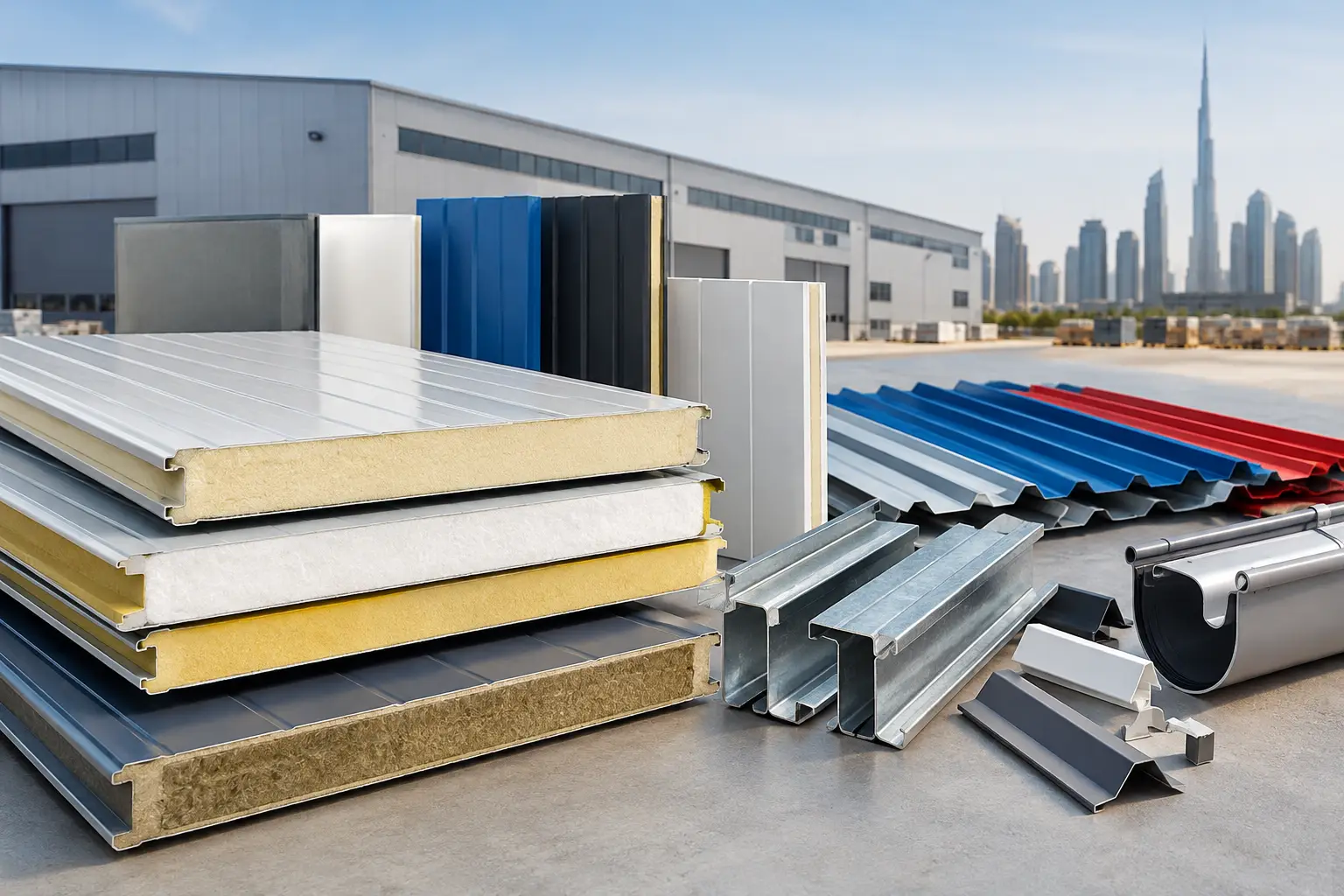
A sandwich panel order can look straightforward on a quotation, yet the wrong material selection or an incomplete delivery can delay installation across an entire roof, facade, or cold storage enclosure. For contractors and project teams, choosing sandwich panel suppliers is not only about obtaining a competitive rate. It is about confirming that the panels, accessories, documentation, and delivery plan suit the actual requirements of the build.
In the UAE, project conditions add another layer of consideration. Heat exposure, moisture, internal temperature control, fire requirements, structural layouts, and site access can all influence the right panel specification. A dependable supplier helps bring these requirements into focus before materials reach the site.
Start With the Application, Not the Panel Price
Sandwich panels are used across warehouses, factories, commercial buildings, prefab structures, site offices, cold rooms, and cold storage facilities. Although they share a similar layered construction, panels intended for these applications are not automatically interchangeable.
A roofing system may require a profile designed to manage water runoff and accommodate the building layout. Wall cladding may prioritize appearance, joint details, insulation performance, and compatibility with flashings. Cold room panels require particular attention to thermal continuity, panel joints, door openings, and internal hygiene requirements.
Before requesting quotations, prepare a clear project brief. It should identify whether the panels are for a roof, wall, partition, cold room, or another enclosure; the required dimensions and quantities; the desired core type; color preferences where relevant; and the proposed installation date. If drawings are available, sharing them early reduces the risk of ordering unsuitable lengths, missing trims, or incompatible accessories.
The lowest initial panel rate may not represent the lowest project cost. A cheaper panel that does not match the required application can create additional fabrication, replacement, or installation work later. Pricing matters, but it should be reviewed alongside specification accuracy and supply completeness.
What Reliable Sandwich Panel Suppliers Should Clarify
A professional supplier should ask practical questions rather than issue a generic quote based only on square meters. The project team needs confidence that the offered material aligns with the intended use.
Core Material and Insulation Requirements
PU and PIR insulated sandwich panels are common choices for roofing, wall cladding, and controlled-environment applications. The appropriate selection depends on the project’s insulation needs, fire-related requirements, panel thickness, and system design.
Fire-retardant panel requirements should be treated carefully. The buyer should communicate the project specification and any consultant or authority requirements at the quotation stage. Suppliers should provide product information that allows the contractor and consultant to assess suitability, rather than making broad assumptions about compliance.
For cold rooms and cold stores, the panel core and thickness are only part of the decision. The full enclosure detail matters. Panel junctions, ceiling connections, floor interfaces, openings, sealants, and accessories all affect the finished system. A supplier with experience in cold storage materials can help identify the items that should be included in the order.
Steel Facing, Coating, and Finish
The external and internal steel facings protect the insulation core and influence the finished appearance of the building. Ask for clarity on coated steel type, sheet thickness, finish, and available colors. This is particularly relevant for exposed roofing and wall systems, where consistent appearance and appropriate material selection support a professional installation.
In coastal or industrial environments, project teams should consider the exposure conditions before selecting panel finishes. There is no single answer for every site. The correct choice depends on building location, surrounding conditions, maintenance expectations, and the specification issued for the project.
Panel Profile, Dimensions, and Joint Details
Panel length, effective cover width, profile shape, and joint configuration affect material quantities and installation planning. Long panels can reduce the number of horizontal joints in some applications, but transport, offloading, site handling, and installation equipment must be considered.
A useful supplier will review the requested lengths against practical delivery and handling conditions. This is especially valuable for projects with constrained access, staged installation, or limited storage space. Ordering panels in the right sequence can be as important as ordering the right total quantity.
Evaluate the Full Supply Package
Panels alone rarely complete a roofing, cladding, or cold room package. Missing supporting materials can cause avoidable work stoppages, even when the main panels have arrived on time.
For most projects, the supplier should be able to identify related materials such as flashings, ridge caps, gutters, corner trims, closures, fasteners, sealants, and panel accessories. Roof and wall systems may also require compatible PPGI or PPAL sheets, profiled single-skin sheets, galvanized steel sheets, Z and C purlins, or floor decking sheets depending on the scope.
This does not mean every project should be sourced as one package. Some contractors have established supply channels for structural steel or fasteners. However, consolidating relevant materials with one capable supplier can simplify coordination, reduce mismatched finishes, and make delivery scheduling easier.
When reviewing a quotation, check whether accessories are clearly separated from the panel supply. Confirm quantities, lengths, colors, thicknesses, and any site-cutting allowance. Vague descriptions can lead to confusion after the order is placed.
Delivery Reliability Is a Project Requirement
Construction schedules are built around material availability. A supplier’s ability to communicate realistic lead times, prepare materials accurately, and coordinate delivery matters as much as the quality of the panels themselves.
Ask how the supplier plans to manage delivery in relation to your installation schedule. For a warehouse roof, panels may need to arrive in stages as structural bays become available. For a cold room project, installers may need panels, doors, trims, and accessories coordinated within a narrow window. For remote or industrial sites, transport arrangements and unloading requirements should be discussed well in advance.
Reliable delivery does not mean making unrealistic promises. It means providing clear information, raising potential constraints early, and coordinating with the contractor when project dates change. This allows site teams to plan labor, lifting equipment, storage, and installation sequencing with fewer surprises.
Across Dubai, Abu Dhabi, Sharjah, Ajman, Ras Al Khaimah, Fujairah, and industrial locations throughout the UAE, access conditions can vary widely. A supplier that understands local project logistics can support more practical planning from the beginning.
Compare Quotations on a Like-for-Like Basis
Procurement decisions become difficult when quotations use different descriptions or leave important details unstated. Before comparing prices, ensure each offer covers the same panel type, thickness, core, steel facing, coating, profile, color, panel lengths, trims, accessories, quantities, and delivery scope.
Also review whether taxes, transport, offloading, packaging, and site delivery conditions are defined. A quotation that appears lower may exclude items that will be needed later. Clear commercial terms help procurement teams make informed decisions and avoid budget adjustments after approval.
Technical support has value here as well. If a supplier can explain why a certain panel thickness, profile, or accessory is proposed, the project team can assess the recommendation against drawings and specifications. Good support is not about overcomplicating the purchase. It is about making sure that the order matches the installation requirement.
Questions Worth Asking Before You Place an Order
Before confirming a sandwich panel supplier, ask whether the proposed panels suit the specific application, whether the offer includes all necessary trims and accessories, and whether the delivery schedule is achievable for the site program. Request confirmation of panel dimensions, coating details, color, quantities, and applicable product documentation.
It is also sensible to discuss handling requirements. Panels should be stored, lifted, and installed according to appropriate site practices to avoid damage to facings, edges, and joints. The supplier can often provide practical guidance that helps the contractor organize receiving and storage before delivery.
For repeat contractors, a reliable supply relationship can improve future procurement. When the supplier understands the contractor’s typical building types, installation methods, and preferred material ranges, quotation and coordination can become more efficient without sacrificing project-specific checks.
A Supplier Should Support Better Decisions
The right supplier brings more than stock availability. They help contractors and project managers identify the panel system that fits the job, clarify what is included, and plan material delivery around real site conditions.
MetalSpan Trading FZE LLC supplies PU and PIR insulated sandwich panels, fire-retardant panels, cold room panels, roofing and cladding sheets, steel components, and related accessories for construction projects across the UAE. The focus should always remain practical: suitable materials, clear specifications, competitive pricing, and dependable coordination.
Before the purchase order is issued, take time to verify the complete package. A clear conversation about application, specifications, accessories, and delivery can prevent the small omissions that become major site delays.