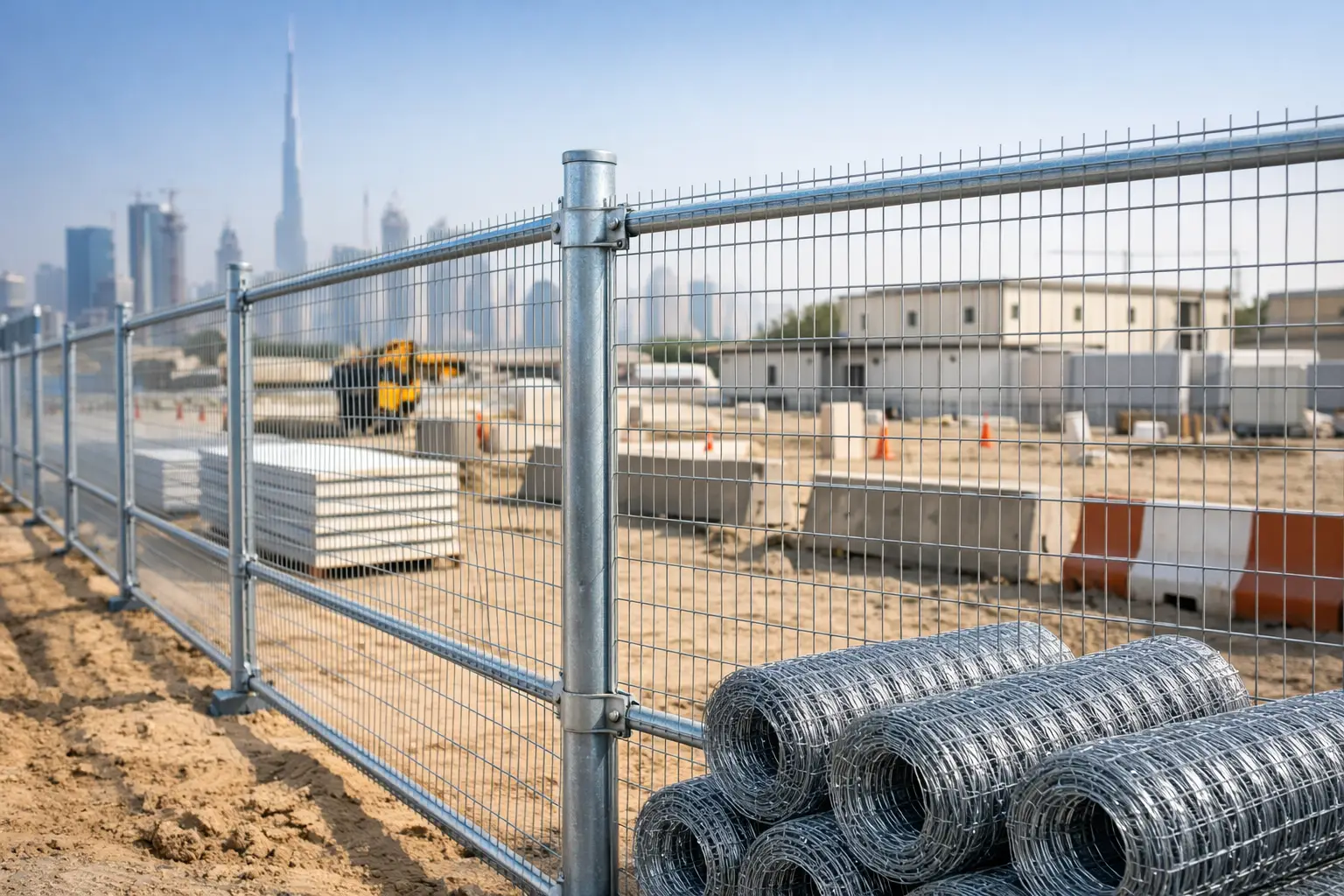
A site boundary is often one of the first items installed on a construction project, yet fencing is not always given enough attention during the planning stage. Poorly specified GI fencing can result in loose mesh, corroded cut ends, leaning posts, weak gates, and repeated maintenance costs while the project is still active.
For construction sites, warehouses, factories, storage yards, industrial facilities, and prefab buildings in the UAE, the fencing specification should consider security requirements, wind exposure, ground conditions, installation method, and the expected service period.
GI fencing is widely used because it is practical, durable, easy to install, and suitable for both temporary and permanent boundary applications. Although the market commonly uses the term “GI fencing” for galvanized iron fencing, many products are actually manufactured using galvanized steel wire, mesh, and tubular sections. Procurement teams should therefore confirm the actual material, galvanizing, dimensions, and installation scope before ordering.
What Does GI Fencing Include?
A complete GI fencing system is more than just a roll of mesh. Depending on the project, it can include:
- Galvanized chain-link or welded wire mesh
- GI line, corner, and end posts
- Top rails or support rails
- Tension wire and tension bars
- Clamps, ties, brackets, and other fixing accessories
- Pedestrian and vehicle gates
- Gate frames, hinges, locks, and wheels
- Concrete foundations and installation accessories
Each component contributes to the overall strength and performance of the boundary. A good-quality mesh can still perform poorly if the posts are undersized or the foundations are not suitable for the ground conditions.
Chain-Link vs. Welded Mesh
GI chain-link fencing is commonly used for construction sites, industrial plots, warehouses, storage yards, and general perimeter control. Its open pattern provides good visibility and airflow, while its flexibility makes it suitable for sites with minor ground variations.
GI welded mesh fencing provides a more rigid and uniform appearance. It can be suitable where a cleaner boundary is required, but accurate post spacing and proper installation are important to maintain alignment and prevent damage to the welded sections.
The right option depends on the project's security requirements, appearance, installation conditions, budget, and expected service life.
How to Specify GI Fencing for UAE Projects
The first step is to identify the purpose of the fence. A temporary construction-site boundary may have different requirements from a permanent factory, warehouse, or industrial facility.
1. Specify Fence Height
Fence height should be selected according to the required level of security, site conditions, and project requirements.
A lower fence may be suitable for internal segregation or low-risk areas, while taller fencing may be required for construction sites, industrial yards, and areas where unauthorized access needs to be discouraged.
The fence height should be clearly stated in the enquiry or purchase order so suppliers can provide comparable quotations.
2. Specify Mesh Size and Wire Thickness
Mesh opening and wire diameter are important factors when comparing GI fencing.
Larger mesh openings can reduce material usage and cost while maintaining visibility and airflow. Smaller openings provide a more closely controlled boundary but may increase weight and material cost.
When requesting a quotation, specify:
- Mesh opening size
- Wire diameter
- Fence height
- Mesh type
- Roll or panel dimensions
- Galvanizing specification
Avoid comparing fencing only by price per running meter. Two products may have the same height but different wire thicknesses, mesh openings, and coating levels.
3. Check the Galvanized Coating
Galvanizing provides corrosion protection to the steel, but the suitability of the coating depends on the application and environmental conditions.
For UAE projects, site conditions should be considered carefully, particularly in coastal or industrial locations where moisture, salts, and other environmental factors can affect steel components.
The condition of the galvanized surface after installation is also important. Scratches, damaged coating, exposed cut ends, and rough handling can create areas where corrosion may start earlier.
Installation teams should handle the mesh and posts carefully and repair or protect damaged areas where necessary.
4. Specify Posts and Foundations
Posts are responsible for supporting the fencing system and maintaining its alignment. Corner, end, and gate posts are particularly important because they carry additional loads and mesh tension.
The specification should consider:
- Post type and dimensions
- Post wall thickness
- Post spacing
- Corner and end-post arrangements
- Bracing requirements
- Foundation size and depth
- Soil and ground conditions
Wind exposure should also be considered. Open construction sites and industrial plots can experience significant wind loads, so a standard post arrangement may not be suitable for every location.
Where the ground is loose, filled, uneven, or otherwise difficult, the foundation arrangement may need to be adjusted.
5. Plan the Gates Separately
Gates are one of the most frequently used parts of a fencing system and should not be treated as an afterthought.
For pedestrian gates, consider the required opening width, frame strength, hinges, latch, and locking arrangement.
For vehicle gates, consider the size and type of vehicles entering the site. Construction projects may require access for trucks, forklifts, cranes, delivery vehicles, or emergency vehicles.
Sliding gates can be useful where there is limited swing clearance, while swing gates may be suitable where sufficient space is available.
Gate posts should be stronger and properly founded because they carry repeated operational loads.
6. Consider the Site Conditions
A site survey before finalizing the fencing quantity can prevent many installation problems.
Check for:
- Uneven or sloping ground
- Existing walls and buildings
- Underground services
- Drainage channels
- Vehicle entrances
- Corners and boundary changes
- Restricted access areas
- Coastal or exposed locations
The fence layout should be coordinated with roads, security cabins, lighting, drainage, and other site facilities.
Common GI Fencing Procurement Mistakes
The lowest quotation is not necessarily the lowest overall project cost. Some fencing quotations may cover only the mesh and posts while excluding accessories, gates, concrete, installation, transport, or unloading.
Before placing an order, confirm exactly what is included.
A proper GI fencing enquiry should clearly mention:
- Mesh type and opening size
- Wire diameter
- Fence height
- Galvanized coating or finish
- Post type, size, thickness, and spacing
- Bracing requirements
- Gate quantity and dimensions
- Gate hardware and locking arrangement
- Concrete and foundation scope
- Installation or erection requirements
- Transportation and unloading
- Expected delivery schedule
This makes it easier to compare quotations from different suppliers and reduces the possibility of additional costs during installation.
Planning GI Fencing for Construction Projects
For active construction projects, fencing should be planned early enough to establish secure boundaries before major site activities begin.
The site may require separate access for workers, visitors, material deliveries, waste removal, and heavy vehicles. Gate positions should therefore be decided before the fencing installation starts.
If temporary fencing will later be replaced with a permanent boundary, the two stages should be coordinated where possible. This can reduce unnecessary reconstruction of gates, foundations, access roads, and boundary sections.
Material storage is also important. GI mesh rolls, posts, rails, and gate frames should be stored in a suitable area and protected from standing water, excessive site traffic, and unnecessary handling. Proper storage helps maintain the galvanized finish before installation.
Why Proper Specification Matters
GI fencing may appear to be a simple construction item, but its performance depends on the complete system rather than the mesh alone.
A suitable combination of mesh, posts, foundations, gates, accessories, and installation methods can provide a secure and durable boundary throughout the project.
For UAE construction, industrial, warehouse, and prefab projects, the best GI fencing solution should balance security, durability, environmental conditions, installation requirements, and budget.
MetalSpan Trading FZE LLC can support GI fencing requirements with suitable product specifications and supply coordination for UAE projects.
A properly specified fence helps create a safer, more organized site from the beginning of construction through project completion.