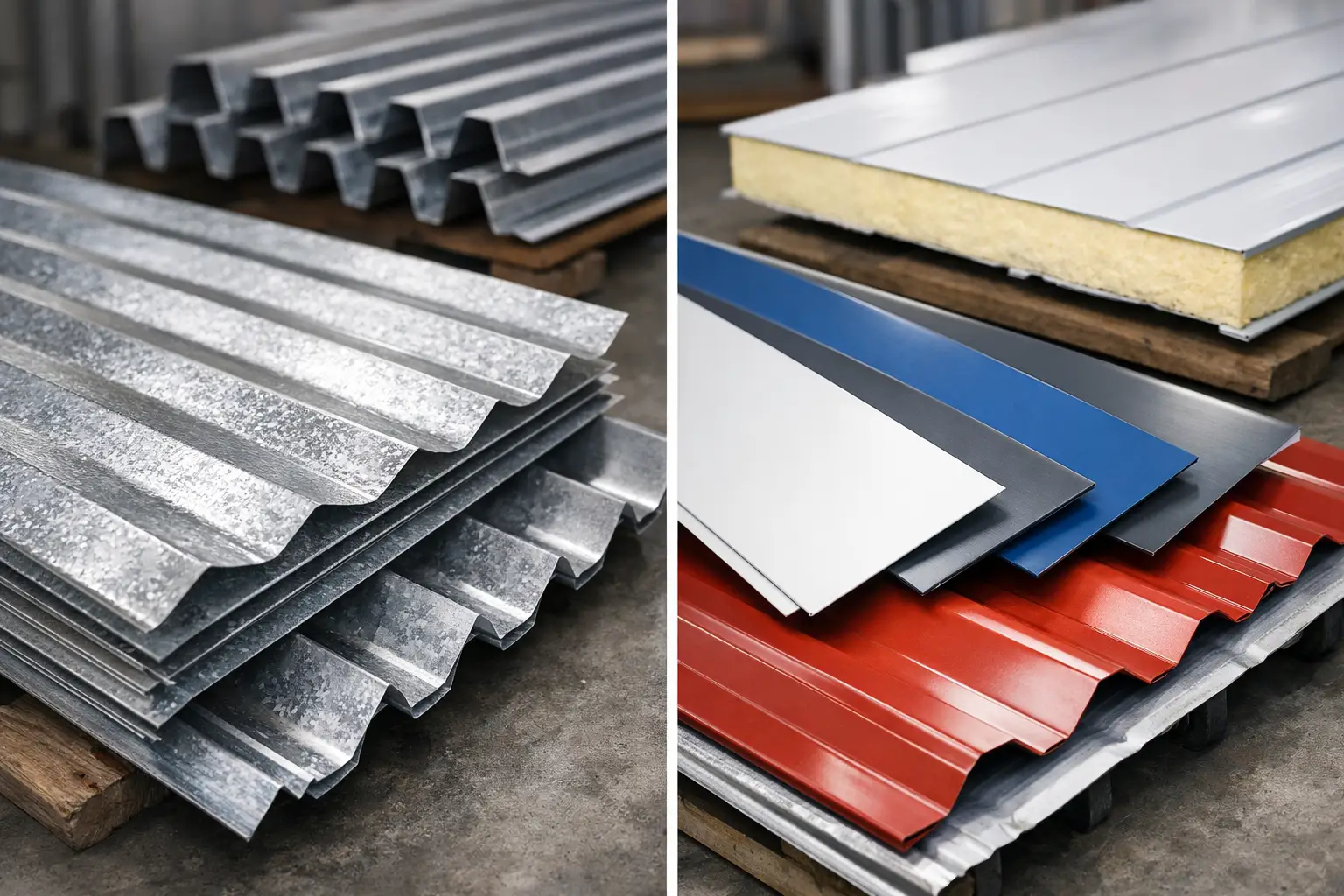
A roofing sheet can look suitable at the quotation stage and still become the wrong material once it is exposed to heat, moisture, dust, or coastal air. The choice between galvanized versus coated steel sheets affects not only the appearance of a building, but also corrosion protection, maintenance expectations, fabrication requirements, and project cost over time.
For warehouses, factories, prefab buildings, labor accommodation, and commercial projects, there is no single correct answer. Galvanized steel is often a practical choice where a metallic finish and straightforward protection are sufficient. Coated steel sheets are commonly selected where color, surface finish, and additional protection against the operating environment are higher priorities. The right specification depends on the building location, roof or wall application, sheet profile, and the details of the coating system.
Galvanized Versus Coated Steel Sheets: The Core Difference
Galvanized steel sheet is carbon steel protected by a zinc coating. The zinc layer acts as a barrier between the steel and the environment and provides sacrificial protection if the surface receives minor damage. Its recognizable silver-gray finish makes it a familiar material for roofing components, fabrication work, flashings, gutters, and general construction applications.
Coated steel sheet usually refers to steel with an applied organic finish, such as pre-painted galvanized iron (PPGI) or pre-painted aluminum-zinc coated steel (PPAL). The base metal already has a protective metallic layer, and the paint system adds color and another protective surface layer. This makes coated sheets a common choice for visible roofing and wall cladding where the client requires a defined color and a more finished appearance.
The terms can sometimes cause confusion because coated products are not all built the same way. A coated sheet may have a galvanized base, an aluminum-zinc base, different paint types, and varying coating thicknesses. Procurement teams should therefore compare the full specification, not just the label "coated steel."
When Galvanized Sheets Make Practical Sense
Galvanized steel sheets are valued for their functional finish, broad construction use, and direct cost structure. They are often appropriate for applications where visual appearance is secondary, where the sheet will be further fabricated, or where the project specification calls specifically for galvanized material.
For fabricators, galvanized sheets can be a practical material for producing flashings, trims, gutters, duct-related components, and support elements. They also suit projects where a painted surface could be damaged during extensive forming or handling. A metallic zinc finish will show fingerprints, surface variation, and eventual weathering more readily than a painted sheet, but this may be acceptable for utility-focused applications.
The zinc coating weight is a key consideration. More zinc generally provides a greater protective reserve, but the required level should match the project environment and the intended service conditions. A sheet selected only on base-metal thickness, without reviewing zinc coating weight, may not provide the protection level expected for the application.
Galvanized sheets are not automatically the lowest-cost choice in every case. Pricing changes with steel markets, coating weight, thickness, width, and supply availability. Still, for projects that do not need a colored finish, galvanized steel can avoid the added cost of a paint system.
Why Coated Steel Is Often Chosen for Roofing and Cladding
Coated steel sheets provide a clean, consistent finish that supports the architectural requirements of industrial, commercial, and prefab construction. Available colors allow roofing and wall systems to align with building designs, corporate color schemes, or surrounding developments without requiring site painting.
The paint system also creates a surface barrier that helps reduce direct exposure of the metallic coating beneath it. This layered protection is particularly relevant for exterior building envelopes, where sheets face strong sunlight, changing temperatures, humidity, airborne dust, and occasional standing water around poorly detailed areas.
That said, color-coated steel should not be treated as a generic product. Its suitability depends on the coating type, coating thickness, base-metal protection, and application. A sheet intended for an internal partition or sheltered wall may not be the right choice for an exposed roof. Similarly, a standard color-coated sheet may require closer evaluation for buildings near the coast or in areas with industrial airborne contaminants.
For visible wall cladding, coated steel has another clear advantage: it retains a more uniform appearance than plain galvanized sheet. This can reduce the need for additional finishing work and gives contractors a ready-to-install exterior surface when profiles, flashings, and accessories are properly matched.
Environmental Conditions Matter in the UAE
In the UAE, sheet selection should account for more than high daytime temperatures. Buildings can experience intense UV exposure, sand abrasion, humidity, condensation inside poorly ventilated spaces, and salt-laden air in coastal locations. Industrial zones may also have environmental conditions that justify a more carefully specified coating system.
A warehouse in an inland location and a facility close to the shoreline should not necessarily use the same sheet specification. The coastal project may require closer attention to the metallic coating, paint system, fasteners, cut edges, and the overall drainage design. Corrosion often begins at vulnerable details rather than across the center of an intact sheet.
Roof geometry matters as well. Low-slope roofs need reliable drainage so water and debris do not remain around side laps, penetrations, gutters, or end laps. Even a high-quality sheet can underperform if the installation creates water traps or if incompatible materials are used together.
For cold rooms and temperature-controlled buildings, the panel or cladding specification should also consider internal humidity, joint sealing, and the building's operating conditions. Exterior color-coated skin selection is only one part of a complete building-envelope decision.
Compare the Specification, Not Just the Sheet Price
A lower quoted price can be misleading when the materials being compared have different thicknesses, coating weights, paint systems, or effective cover widths. Before approving a purchase, contractors and project managers should confirm the details that affect performance and quantity.
For galvanized sheet, verify the steel thickness, zinc coating designation, sheet width, profile, and intended use. For coated sheet, review the base metal, paint type, paint thickness where specified, color, finish, reverse-side coating, and protective film requirements. The profile depth and effective cover width also affect the number of sheets needed for a roof or wall area.
It is equally useful to confirm the accessories at the same time. Matching ridge caps, flashings, gutters, closures, fasteners, and sealants help create a more complete system. A coated roof sheet paired with poorly matched trims or unsuitable fasteners can compromise both appearance and service life.
Material handling should be part of the buying decision. Coated sheets need careful unloading, storage, and installation to prevent scratches, edge damage, or pressure marks. Galvanized sheets also need dry, ventilated storage, since trapped moisture between stacked sheets can lead to staining or surface deterioration. Ordering the correct lengths can reduce site cutting, which in turn limits exposed edges and installation waste.
A Decision Framework for Contractors and Buyers
Choose galvanized steel when the project needs a practical metallic sheet, fabrication flexibility, or a budget-conscious material for applications where the natural finish is acceptable. It can be a sound option when its coating weight and thickness are appropriate for the environment.
Choose coated steel when the project requires color, a finished external appearance, and a specified paint system for roofing or wall cladding. It is often the more suitable option for customer-facing buildings, prefabricated structures, warehouses with visible elevations, and projects where a coordinated building envelope is required.
For either option, avoid deciding based on appearance alone. Request a clear specification that states the substrate, thickness, coating details, profile, quantity, and required accessories. This gives purchasing teams a fair basis for comparing quotations and helps installers receive materials that match the approved drawings.
MetalSpan Trading supports contractors, fabricators, and project teams with galvanized sheets, PPGI and PPAL coated sheets, profiled roofing and wall cladding, and related accessories for building projects across the UAE. A practical discussion before ordering can help align the sheet selection with the site environment, visual requirement, and budget.
The best choice is the sheet that fits the complete project condition, not simply the one with the lowest initial rate. When the specification matches the exposure, profile, installation details, and intended finish, the roof or wall system starts with a stronger foundation.