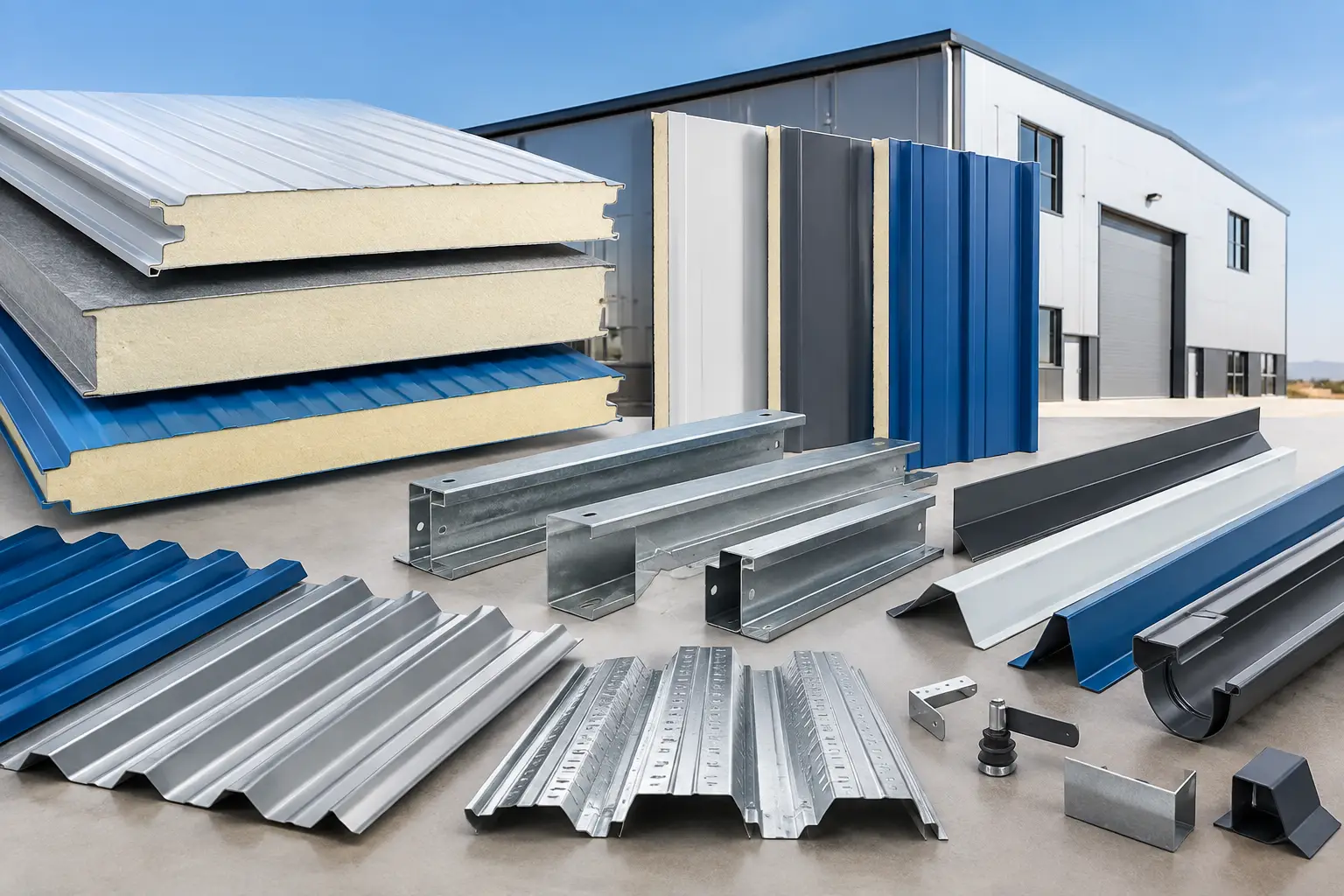
A sandwich panel system is only as dependable as the details that connect, seal, and finish it. Essential sandwich panel accessories help contractors protect panel edges, manage water flow, close gaps, and achieve a clean installation across roofs, walls, warehouses, factories, prefab buildings, and cold storage projects.
Panels receive most of the attention during procurement, but accessories should be specified at the same time. A missing closure, an unsuitable fastener, or poorly planned flashing can create site delays and compromise the finished appearance. For project managers and contractors, selecting compatible accessories early supports accurate material planning, controlled installation, and better long-term maintenance.
Why Sandwich Panel Accessories Matter
Insulated sandwich panels combine external metal skins with an insulated core to provide a practical building envelope. However, panels require properly designed connections at ridges, corners, eaves, openings, joints, and terminations. These areas are exposed to rain, wind, dust, temperature movement, and regular building use.
Accessories create the transitions that standard panel profiles cannot complete on their own. They cover cut edges, direct water away from vulnerable joints, support a continuous exterior finish, and help maintain the intended insulation line. On a large warehouse roof or a cold room enclosure, small details can have a significant effect on installation quality.
The right selection depends on the panel profile, panel thickness, orientation, support structure, building geometry, and environmental conditions. A roofing detail should not be treated the same way as a wall corner, and cold storage applications need particular attention at joints and penetrations where air leakage or condensation may become a concern.
Essential Sandwich Panel Accessories by Application
Flashings for edges, corners, and transitions
Flashings are among the most visible and functional accessories in a panel installation. They are formed metal components used to cover and protect junctions between panels and adjacent construction elements. Common examples include corner flashings, base flashings, head flashings, jamb flashings, parapet flashings, and end closures.
For wall cladding, corner flashings provide a neat finish where two panel elevations meet. Base flashings help complete the lower wall edge, while flashing around doors, windows, and service openings covers exposed panel cuts and supports an orderly appearance. The required profile, coating, color, and gauge should be reviewed against the project drawings rather than selected as a generic item.
On roofs, eave and verge flashings are particularly important. They complete the roof perimeter and help guide water toward the gutter system. Correct overlaps, fixing positions, and sealant placement should be followed during installation, especially on low-slope roofs where water management details require close attention.
Ridge caps for roof panel junctions
A ridge cap covers the line where two roof slopes meet. Beyond providing a finished appearance, it protects the upper panel ends and helps manage water at one of the roof's most exposed locations. Ridge caps must suit the roof panel profile and pitch so they sit correctly over the panel crowns and overlaps.
A ridge assembly may also require profile fillers, closure strips, fasteners, and sealant. Treating the ridge cap as a standalone item can lead to incomplete material orders. Contractors should confirm the full ridge detail, including ventilation requirements where applicable, before finalizing quantities.
Gutters and rainwater accessories
Roof drainage should be planned as part of the panel system, not after roof installation has started. Gutters collect water at the eaves and direct it to designated discharge points through compatible outlets and downpipes. Their size and arrangement depend on roof area, slope, expected water flow, and the building layout.
For industrial buildings in the UAE, gutters also need practical consideration for dust accumulation and access for cleaning. A well-planned gutter line supports a tidy roof edge and reduces the risk of water collecting near sensitive wall, eave, or entry details. Brackets, outlets, stop ends, and joint pieces should be included in the procurement schedule where required.
Fasteners and sealing washers
Fasteners secure sandwich panels to steel or other approved support structures. The appropriate fastener length depends on panel thickness, support type, and fixing detail. Using a fastener that is too short can reduce effective engagement with the support, while an excessively long fastener may be inefficient or create avoidable installation issues.
Roofing fasteners commonly use sealing washers to help close the fixing point against water entry. The washer must sit correctly during installation. Over-tightening can deform the washer, while under-tightening may leave an incomplete seal. Installation teams should use appropriate tools and maintain consistent fixing alignment for a professional finish.
Fastener quantity is not simply a matter of panel area. It varies by panel length, roof location, wind exposure, support spacing, and project requirements. The project engineer or approved installation detail should determine the final fixing pattern.
Closure strips and profile fillers
Closure strips and profile fillers are shaped to match the contour of a roofing panel profile. They are typically used at eaves, ridges, and other profile openings to help close gaps beneath flashings or between panel components. This assists with preventing the entry of dust, insects, and wind-driven rain while improving the appearance of the completed detail.
These small components are easy to overlook because they represent a modest portion of the total order value. Yet they can be difficult to add once the panels and flashings are already installed. Include them in the initial material takeoff and confirm that they match the actual panel profile being supplied.
Sealants, tapes, and joint accessories
Sealants and sealing tapes support weather-tight panel joints and finishing details. They are used at overlaps, flashing connections, roof penetrations, and selected wall junctions. The correct product depends on whether the joint is exposed to weather, subject to movement, or located in a temperature-controlled enclosure.
For cold rooms and cold stores, joint sealing deserves additional planning. The goal is to create a continuous insulated enclosure with carefully sealed joints around corners, floors, ceilings, doors, and service penetrations. The panel layout and accessory details should be coordinated before installation begins, since later alterations can add cost and complexity.
Purlin interfaces and support details
Sandwich panels are often installed over steel purlins, rails, or structural framing. While purlins are structural components rather than panel accessories, the interface between the two is critical. Panel span capability, support spacing, fixing locations, and alignment need to correspond with the approved panel specification.
An accessory order should therefore be coordinated with the steelwork package. This avoids common site problems such as misaligned supports, missing edge framing, or insufficient backing at openings. Where Z and C purlins, flashings, and panel accessories are sourced together, procurement teams can more easily coordinate quantities and site delivery requirements.
How to Specify Accessories Before Ordering
The most effective approach is to prepare a panel accessory schedule alongside the panel quantity schedule. Start with the roof and wall drawings, then identify every perimeter, corner, opening, ridge, eave, gutter line, and junction with another material. Record the panel type, thickness, profile, color, and orientation for each elevation.
Next, confirm the accessories required for each detail. A wall corner may need an external corner flashing and suitable fasteners. A roof eave may require an eave flashing, gutter, closure strip, fasteners, and sealing materials. A door opening may require head, jamb, and sill flashings, depending on the design.
Quantity calculations should allow for practical lengths, overlaps, cuts, and site handling. Standard-length flashings can reduce waste on simple elevations, but customized lengths or profiles may be more suitable for complex building geometry. The best choice depends on the project design, installation sequence, and available handling capacity on site.
It is also useful to agree on color matching early. Flashings, ridge caps, gutters, and trims are highly visible. Coordinating their finish with the panel face improves the completed appearance and avoids last-minute substitutions that may not suit the building design.
Common Procurement Mistakes to Avoid
The most frequent issue is ordering panels first and treating accessories as a later purchase. This can delay installation when site teams discover that a ridge cap, corner flashing, or matching closure is unavailable when needed. Another mistake is assuming that one flashing profile will suit every panel thickness or junction condition.
Projects can also run into difficulty when accessories are selected without considering the installation method. For example, panel fixing locations need to align with the supporting steelwork, and gutters need adequate support and drainage planning. Drawings, takeoffs, and site measurements should be reviewed together before purchase orders are released.
A practical supplier can help contractors organize a complete materials package based on drawings and project requirements. MetalSpan Trading FZE LLC supplies sandwich panels, flashings, ridge caps, gutters, steel sheets, purlins, and related accessories for construction projects across the UAE, supporting procurement teams with material options suited to their scope.
A well-finished panel project is built through careful coordination, not last-minute additions. Specify the accessory details early, verify compatibility with the panel system, and give installation teams the materials they need to complete every edge, joint, and transition with confidence.