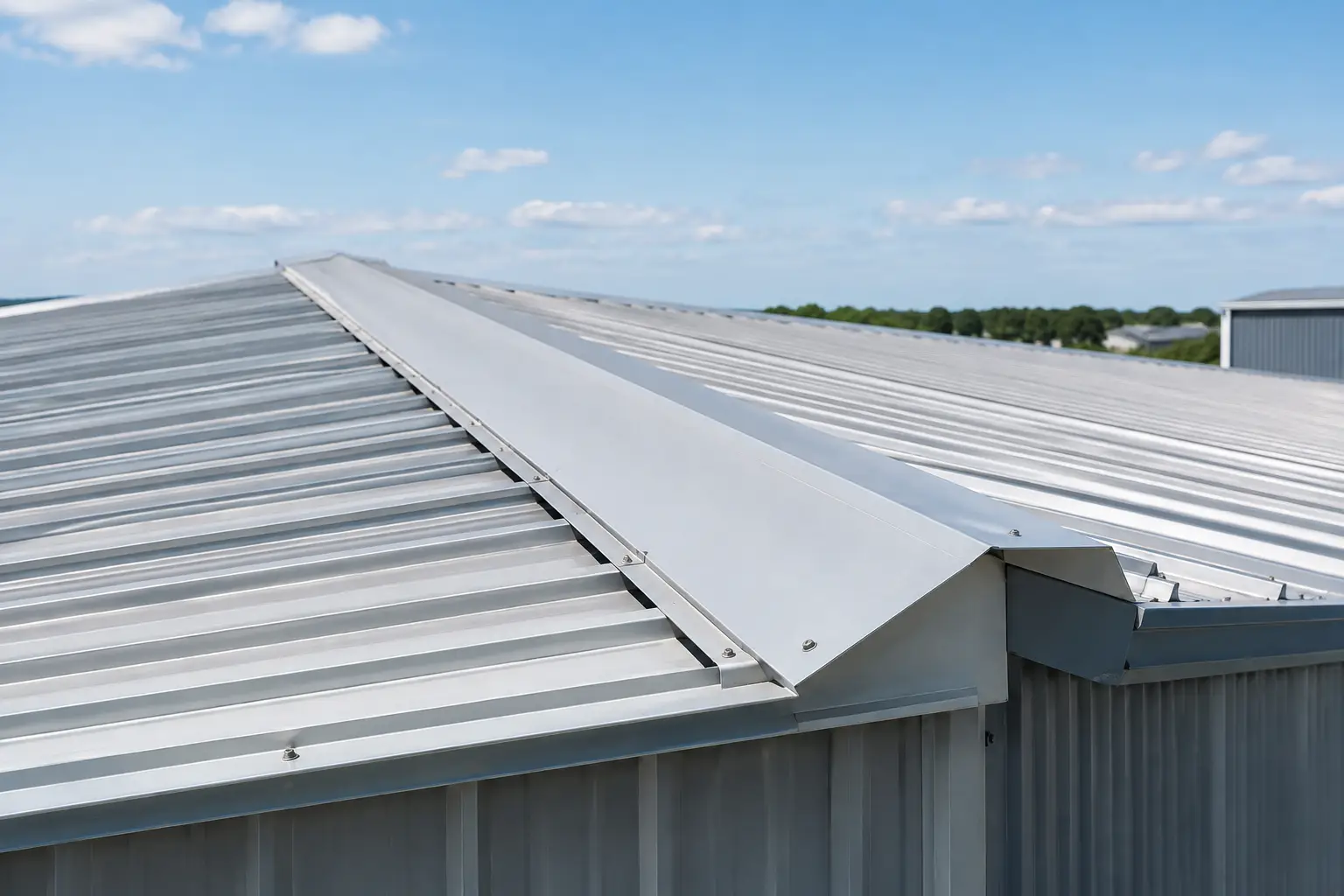
A warehouse roof can use high-quality sheets and still develop problems at its most exposed junction if the ridge detail is poorly selected or installed. Choosing warehouse ridge caps is not simply a matter of covering the line where two roof slopes meet. The cap must suit the roof profile, pitch, panel system, coating, fixing arrangement, and expected site conditions. For contractors and procurement teams, getting these details right early can reduce site adjustments, material waste, and avoidable water-entry concerns.
What a Warehouse Ridge Cap Needs to Do
A ridge cap is the formed flashing installed along the highest point of a pitched roof. Its basic purpose is to cover the gap between roof sheets or insulated panels, direct water away from the roof junction, and provide a clean, finished appearance.
On industrial buildings, however, its role is more demanding. Ridge caps are exposed to wind, heat, dust, and repeated thermal movement. They must sit correctly over the roof profile without creating open paths beneath the flashing. The detail also needs to accommodate closures, sealants, and fasteners without crushing the roofing sheet or restricting the normal movement of the metal.
A ridge cap that looks acceptable from ground level may still be unsuitable if it does not match the sheet geometry beneath it. That is why the roof system should be considered as a complete assembly rather than a collection of separate items.
Choosing Warehouse Ridge Caps Starts With the Roof Profile
The first question is straightforward: what profile is being covered? Corrugated, trapezoidal, and other profiled roof sheets have different rib heights, rib spacing, and valley shapes. A standard flat-bent cap may not sit correctly over every profile, particularly where the cap must bridge high ribs or accommodate insulated sandwich panels.
Match the Cap to the Roof Sheet Geometry
The ridge cap should be formed to provide sufficient cover over both roof slopes while allowing it to follow the profile properly. If its legs are too short, the protection at the roof edge may be limited. If the cap is excessively wide without a suitable design, it can be harder to handle, align, and secure cleanly.
Profiled fillers or closure pieces are often needed below the cap. These components close the spaces created by the roof sheet profile and help prevent dust, insects, and wind-driven rain from entering the ridge area. The closure must match the sheet profile as closely as possible. Using a generic filler on a nonmatching profile can leave gaps even when the cap itself appears properly installed.
Check Roof Pitch and Ridge Angle
The ridge angle must suit the roof pitch. A cap bent for one roof angle may not sit evenly on another. Poor contact can create visible gaps, place stress on fasteners, or make sealing more difficult.
For this reason, project drawings should clearly state the roof slope and whether both sides of the ridge have the same pitch. Unequal roof slopes, extensions, and transitions between roof areas may require custom-formed flashings rather than a standard ridge cap. Confirming this before production and delivery is more efficient than modifying long flashing lengths on site.
Select Material and Coating to Suit the Roof System
Material compatibility matters at every roof junction. In most warehouse projects, ridge caps are selected in a coated steel finish that coordinates with the roofing sheets or insulated panels. Matching the base material and coating type supports a consistent appearance and helps ensure the components respond similarly to site exposure.
Color matching is also practical, not only aesthetic. A coordinated ridge cap creates a more complete roof finish, especially on warehouses, factories, commercial units, and prefab structures where the roof is visible from surrounding roads or higher buildings.
The project environment should guide the final coating decision. A warehouse in a relatively sheltered inland location may have different requirements from a facility exposed to coastal air, airborne dust, or industrial activity. The roof sheet specification, client requirements, and project consultant's direction should lead the selection. It is better to specify the ridge cap alongside the roofing material than treat it as a late accessory purchase.
Pay Attention to Cover, Overlap, and Lengths
A ridge cap does not perform on its width alone. The effective cover on each roof slope, end details, and overlaps between individual cap lengths all matter.
Provide Adequate Side Coverage
The cap needs enough side coverage to extend beyond the critical ridge junction and discharge water onto the roof sheets. The exact coverage depends on roof pitch, roof profile, exposure conditions, and the overall flashing design. A shallow roof or an exposed location may need closer attention to this detail than a compact, sheltered roof configuration.
The cap should sit without excessive distortion. Forcing a flashing to bridge unsupported spaces or pressing it too tightly over raised ribs can affect alignment and may compromise the seal at fixing points.
Detail End Laps Carefully
Long warehouse ridges are normally covered using multiple flashing lengths. Each lap should follow the approved installation direction so water sheds over, rather than toward, the joint. Laps need appropriate overlap and sealing where specified by the roof system design.
Short cuts at the end of a ridge are also worth reviewing. The cap must terminate neatly at gable ends, parapets, roof transitions, or adjoining flashings. These interfaces are common places for rushed site work, especially when flashings are ordered without complete dimensions or drawings.
Use the Right Sealing and Fixing Arrangement
A ridge cap relies on more than its formed shape. The sealing and fixing method determines how the assembly behaves over time.
Sealing tapes, profiled closures, and compatible sealants may be used according to the roofing system and project specification. The purpose is to close intended gaps while maintaining the correct drainage path. Applying sealant indiscriminately is not a substitute for a properly designed flashing. In fact, excessive sealant can trap debris or make future inspection more difficult.
Fasteners should be suitable for the roofing material and the supporting structure. Their position, spacing, washer type, and tightening level should follow the approved roof installation details. Over-tightened fasteners can deform the cap or damage the washer. Under-tightened fasteners may not provide consistent contact. The aim is a secure, evenly aligned installation without stressing the sheet or panel.
Before work begins, the installation team should confirm whether fixings are entering purlins, panel support zones, or another approved substrate. This is particularly relevant on insulated sandwich panel roofs, where the panel system and ridge detail need to work together without compressing or damaging the insulated core.
Consider Ventilation and Insulated Roof Requirements
Not every warehouse ridge is ventilated. Where a roof ventilation strategy is included in the building design, the ridge cap must be coordinated with the vent assembly, closures, insect mesh where required, and weather protection components. A standard closed ridge cap should not be assumed to provide ventilation.
For insulated sandwich panel roofs, the ridge detail should maintain continuity at the top of the panels. This may involve specific ridge accessories, insulation infill, closures, and flashing arrangements. The objective is to protect the panel junction while supporting the intended thermal and weather-resistance performance of the roof system.
Cold storage, food-related facilities, and temperature-controlled buildings deserve additional coordination because roof junctions can affect insulation continuity and interior conditions. The appropriate detail should be confirmed against the panel supplier's installation guidance and the project's technical requirements.
Avoid Ordering Before the Details Are Confirmed
Many ridge-cap issues begin in procurement rather than installation. Ordering based only on roof length and color can overlook profile type, ridge angle, cover width, side laps, end closures, and special intersections.
Before requesting a quotation or placing an order, provide the roof sheet or panel profile, roof pitch, ridge length, required material and coating, color, and relevant drawings. Also identify whether the project includes hips, gable ends, parapets, ventilation, roof penetrations, or changes in roof level. These details help the supplier recommend a suitable flashing arrangement and prepare material quantities with fewer assumptions.
For projects across the UAE, site handling should also be considered. Long flashing lengths can reduce the number of overlaps, but they require careful transport, unloading, storage, and lifting to prevent bending or surface damage. The best length is not always the longest available length. It is the length that can be delivered, handled, and installed safely for the actual project conditions.
A Practical Approach to Ridge Cap Selection
The right ridge cap is usually the result of coordinated decisions, not a last-minute finishing choice. Start with the roof profile and pitch, select a compatible material and finish, then confirm coverage, closures, laps, seals, and fasteners against the approved roof detail. This approach helps protect the work already invested in the roof sheets, panels, and supporting steel structure.
MetalSpan Trading can support contractors and project teams with roofing accessories, ridge caps, flashings, and related materials aligned with warehouse and industrial roofing requirements. A clear drawing and complete roof information at the quotation stage give every project a stronger starting point - and a cleaner ridge line when the work is complete.