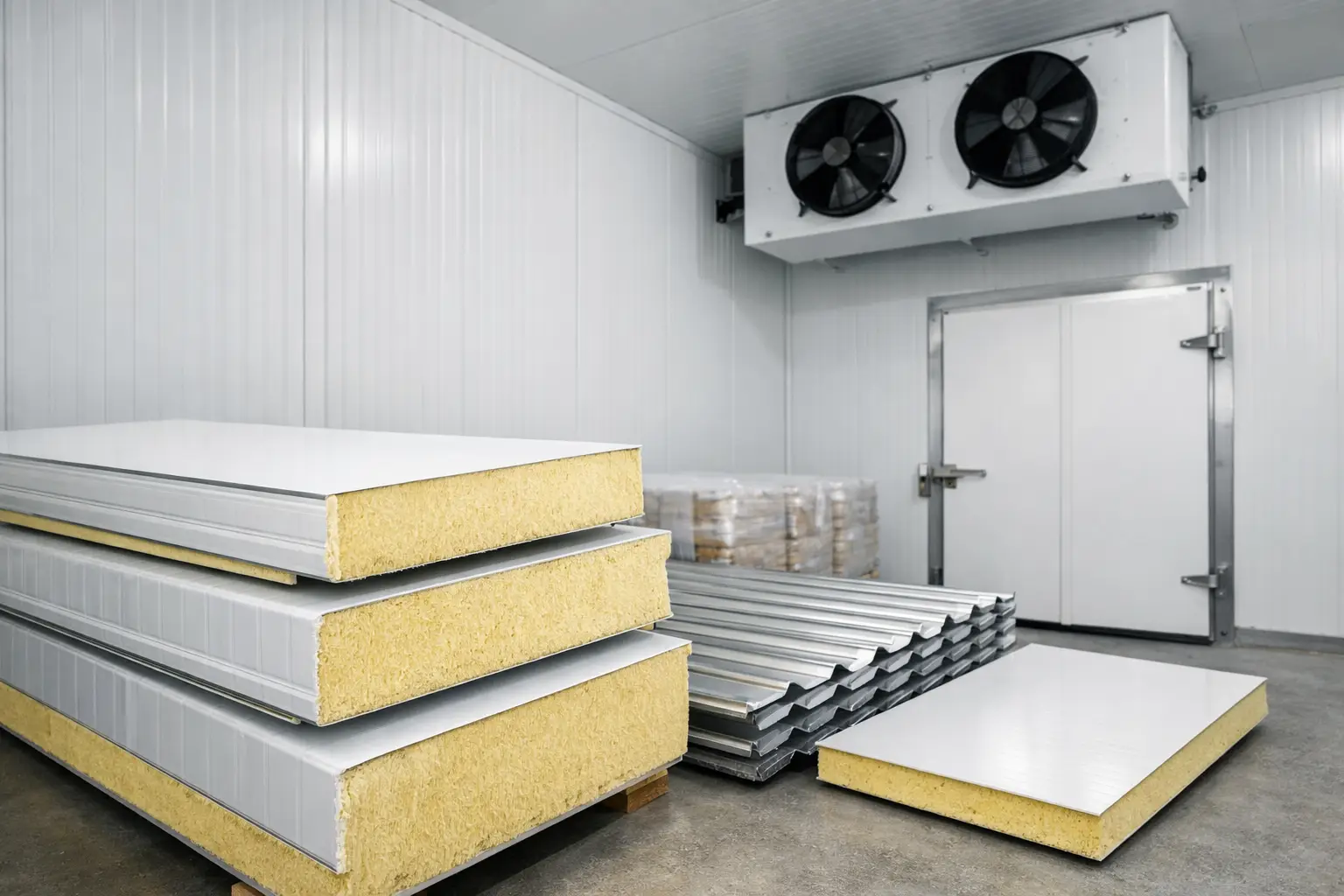
A cold room can have capable refrigeration equipment and still waste energy if its envelope is poorly specified. The best panels for cold rooms are not chosen by insulation thickness alone. They must work as a complete enclosure system, limiting heat gain, controlling moisture entry, supporting hygienic operations, and fitting the project’s temperature range and daily traffic.
For contractors, consultants, and procurement teams, panel selection affects more than the initial material cost. It influences installation time, refrigeration load, maintenance needs, usable internal space, and long-term operating reliability. A practical selection process starts with the cold room’s intended use, then matches the insulation core, panel joint, facing, thickness, and accessories to that requirement.
What Makes a Cold Room Panel Different?
Cold room panels are insulated sandwich panels designed for temperature-controlled spaces such as chilled stores, freezer rooms, food processing areas, pharmaceutical storage spaces, and distribution facilities. They combine an insulated core with protective metal facings, creating walls and ceilings that form a continuous thermal envelope.
The difference is in the details. Cold storage applications place greater demands on joint sealing, vapor control, surface finish, and thermal continuity than many standard building enclosures. Small gaps at panel connections, corners, floor-wall junctions, doors, or service penetrations can allow warm, humid air to enter. That air can create condensation, frost, and higher refrigeration demand.
A suitable panel system should therefore be evaluated as part of the room assembly. The panels, cam-lock or tongue-and-groove connections, sealants, flashings, trims, insulated doors, and installation quality all contribute to final performance.
Best Panels for Cold Rooms: Start With the Insulation Core
PU and PIR insulated sandwich panels are widely specified for cold room construction because they provide effective thermal insulation with relatively slim panel profiles. This helps projects preserve valuable storage capacity while creating a well-insulated enclosure.
PU insulated panels
Polyurethane, or PU, core panels are commonly used in cold rooms where strong thermal performance is a key priority. They are suitable for a wide range of refrigerated storage applications when selected with the appropriate panel thickness, joint profile, facing material, and installation method.
PU panels can be a practical choice when a project needs efficient insulation and straightforward installation. However, the final specification should always reflect the operating temperature, room size, cooling design, and any project-specific fire or insurance requirements.
PIR insulated panels
Polyisocyanurate, or PIR, panels are often considered where thermal efficiency and fire-related performance requirements are both part of the specification. PIR is a different insulation formulation from PU, and its suitability should be reviewed against the required panel system documentation and the authority, consultant, or insurer requirements for the project.
For many commercial and industrial cold storage projects, PIR panels offer a balanced option. The correct decision depends on the full system requirement rather than a simple assumption that one core is right for every room.
Fire-retardant panel requirements
Where fire performance is a key project concern, contractors should verify the panel specification, tested system details, applicable local code requirements, and project approval conditions before procurement. The panel core is only one part of the assessment. Joint design, installation, penetrations, supporting structure, and adjacent materials may also affect the final assembly.
This is particularly relevant for larger facilities, high-value stock areas, and projects with detailed consultant or insurer specifications. Clear technical review before ordering helps prevent late changes, material mismatch, and avoidable site delays.
Select Thickness by Temperature, Not by Habit
Panel thickness should be based on the required internal temperature and the difference between inside and outside conditions. A chilled room and a low-temperature freezer room do not place the same demand on the insulated envelope. In the UAE, high ambient temperatures make this decision especially important for facilities operating for long periods or opening frequently throughout the day.
Thicker panels can reduce heat transfer, but they also affect budget, detailing, door compatibility, and installation planning. Choosing the thickest available panel is not automatically the most economical solution. The goal is to specify a thickness that supports the refrigeration design and intended operating condition without adding unnecessary cost or complexity.
A project team should confirm the room’s target temperature, product loading pattern, expected door openings, external exposure, and refrigeration engineer’s design assumptions. These inputs provide a stronger basis for panel selection than using the same thickness across every cold room project.
Joints and Sealing Matter as Much as the Panel
The most effective insulated panel can underperform if its joints are not properly connected and sealed. Cold rooms require tight panel interfaces to reduce air leakage and moisture migration. Depending on the panel system and application, this may include tongue-and-groove profiles, concealed fixing arrangements, cam-lock connections, joint sealants, and compatible trims.
Cam-lock panel systems can be useful where fast assembly, accurate alignment, or future room modification is required. They are often considered for modular cold rooms and refrigerated storage areas. Fixed panel systems may be suitable for larger or more permanent installations, provided the connection details are properly designed and installed.
Attention is needed at every transition. Ceiling-to-wall junctions, corners, door frames, evaporator supports, pipe penetrations, and electrical openings should be detailed so that insulation and sealing remain continuous. Improvised site cuts and incomplete sealing are common sources of future condensation problems.
Choose Facing Materials for the Operating Environment
The metal facing protects the insulation core and creates the room’s internal and external surfaces. For many applications, pre-painted steel facings provide a clean, practical finish. The appropriate coating, thickness, and finish depend on the environment the panel will face.
A dry chilled warehouse has different demands from a room exposed to regular washdown, food handling activity, humidity, or cleaning chemicals. In higher-moisture or hygiene-sensitive settings, the facing should be selected with durability, cleanability, and corrosion resistance in mind. External conditions also matter, particularly where panels are installed within industrial facilities, exposed service areas, or hot climates.
Discuss the intended use openly during material selection. A panel that is appropriate for general storage may not be the right fit for a processing room or a frequently cleaned cold area.
Do Not Overlook Floors, Doors, and Accessories
Wall and ceiling panels are only part of a cold room package. The floor construction must suit the temperature level, load requirements, and traffic type. Rooms used by pallet jacks, forklifts, or heavy racking need a floor design that addresses structural loading as well as insulation requirements. Freezer floors may also require additional measures to manage the risk of subfloor freezing, based on the project design.
Cold room doors deserve the same level of attention. A poorly fitting door or damaged gasket can create constant air loss, moisture entry, and frost buildup. Door size, opening frequency, threshold detail, hardware, and traffic pattern should be aligned with daily operations.
The same applies to flashings, trims, sealants, fasteners, and closures. These are not minor extras. Correct accessories help maintain a clean finish, protect vulnerable edges, and complete the thermal envelope. Procuring compatible components with the panel system reduces the risk of mismatched details on site.
A Practical Procurement Checklist
Before finalizing a panel order, project teams should have clear answers to the following points:
- Required room temperature and expected operating conditions
- Room dimensions, ceiling height, and layout of doors and service openings
- Insulation core preference and any fire-related project requirements
- Panel thickness, facing finish, and corrosion exposure conditions
- Joint type, sealing method, trims, flashings, and compatible accessories
- Floor loading, internal traffic, and door usage requirements
- Delivery sequence, storage conditions, handling equipment, and installation schedule
This information allows a supplier to recommend a more suitable panel configuration and helps procurement teams compare quotations on a like-for-like basis. A low initial price can be misleading if it excludes essential accessories, uses an unsuitable facing, or does not match the required panel thickness and joint system.
Plan Installation Before Materials Reach Site
Cold room panels should arrive at a site that is ready for them. The supporting structure or slab must be checked for line, level, and dimensions before installation begins. Panels need dry, protected storage and careful handling to avoid damage to edges, coatings, and joint profiles.
Installation should follow an organized sequence, usually beginning with accurate base details and corner alignment before walls, ceilings, doors, and finishing accessories are completed. Sealant application must be consistent and appropriate for the intended temperature range. Teams should also coordinate refrigeration, electrical, drainage, and fire protection penetrations before closing the enclosure wherever possible.
For UAE projects, dependable material planning is particularly valuable when site programs are tight and work is being coordinated across multiple trades. MetalSpan Trading FZE LLC supplies PU and PIR insulated sandwich panels, cold room panels, and compatible construction accessories to support project-specific cold storage requirements.
A well-chosen cold room panel system gives the refrigeration plant a better enclosure to work with. Specify the room around its actual operating conditions, insist on compatible joints and accessories, and treat installation details as part of the material decision. That approach supports cleaner handover, more predictable operation, and a cold room built for the work it needs to do.