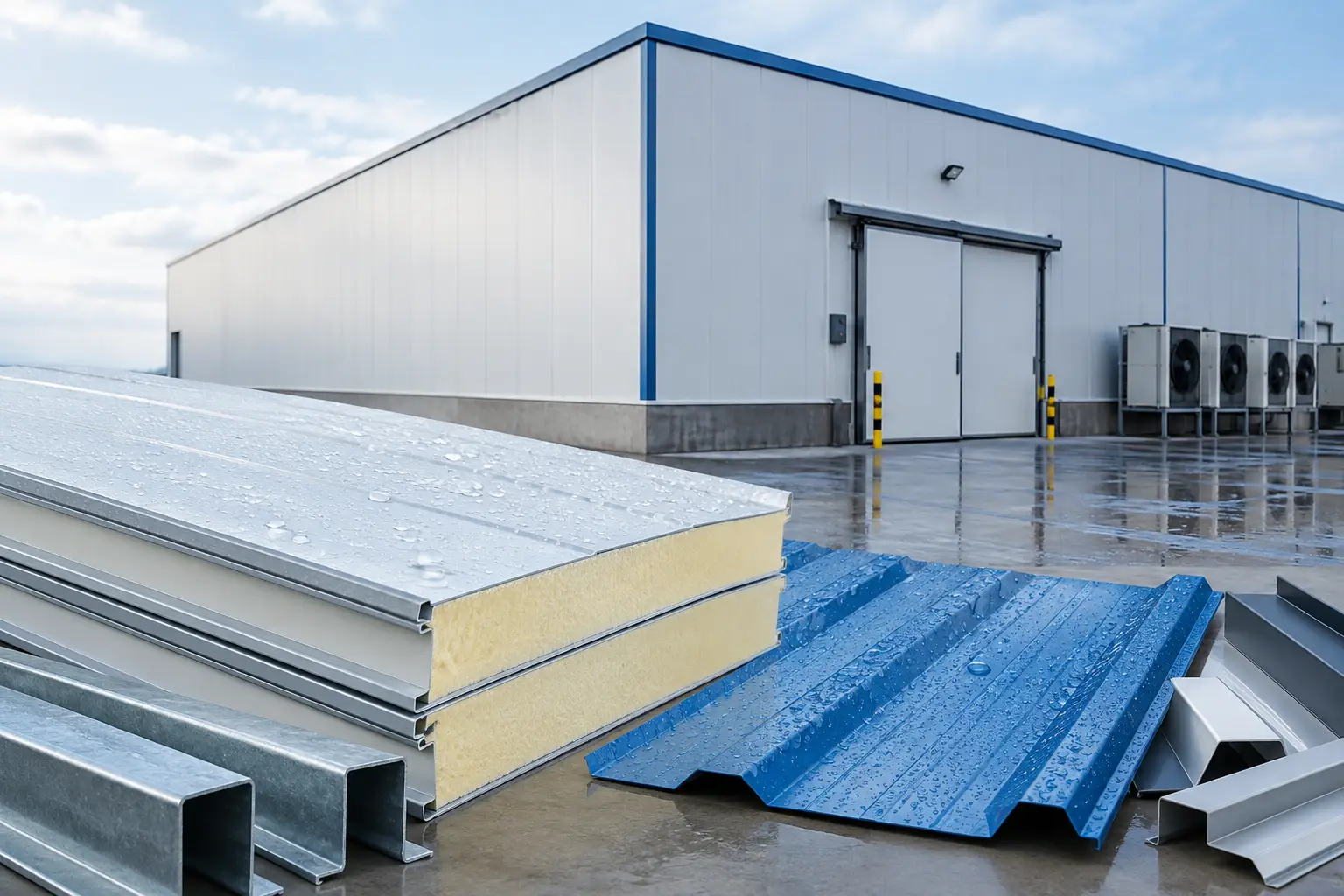
Are cold room panels waterproof? In practical terms, the insulated panel itself is designed to resist moisture, but a cold room becomes water-tight only when its joints, seals, flashings, doors, and penetrations are correctly specified and installed. For contractors and project managers, this distinction matters. A high-quality panel can still perform poorly if water finds a path through an unsealed joint or damaged accessory.
Cold rooms operate in demanding conditions. Temperature differences between the inside and outside create condensation risk, while regular washdown, humid ambient air, and frequent door use can expose the enclosure to water. Selecting suitable panels is the starting point. Creating a complete, sealed system is what protects insulation performance, hygiene, and the life of the facility.
What Makes Cold Room Panels Water-Resistant?
Cold room panels are typically insulated sandwich panels with metal facings and a rigid insulating core, commonly polyurethane (PU) or polyisocyanurate (PIR). The coated metal skins form the first barrier against surface moisture. When the coating is intact and suited to the operating environment, water should not pass through the face of the panel during normal service.
The insulation core also plays an important role. Closed-cell PU and PIR cores are designed to limit moisture absorption far better than many open, fibrous insulation materials. This helps maintain thermal performance if the room is exposed to humid conditions. However, this does not mean the panel can be treated as permanently waterproof under every condition or after damage.
Panel thickness, facing type, coating quality, and the intended temperature range should all be reviewed during procurement. A chilled storage room, a freezer room, and a food-processing area with frequent washdown may require different details even when the basic panel construction appears similar.
Are Cold Room Panels Waterproof at the Joints?
This is where most water-related problems begin. Individual cold room panels may be moisture-resistant, but the panel-to-panel connection is the critical area. Cold room systems commonly use interlocking joints, cam-lock connections, tongue-and-groove profiles, gaskets, or sealant to create a continuous enclosure.
A correctly formed joint limits both water entry and air leakage. This is essential because warm, humid air entering a cold room can condense on colder surfaces. Over time, that moisture can lead to ice formation in freezer applications, corrosion around exposed metal edges, staining, reduced insulation efficiency, and deterioration of surrounding finishes.
Sealant must be compatible with the panel facing, the expected temperature, and the operating conditions. It should be applied continuously, with no gaps at corners or changes in direction. Relying on a panel joint alone, without the required sealant or gasket arrangement, can create a weak point even when premium panels are used.
Water Resistance Depends on the Full Room System
Cold room panels should not be evaluated in isolation. The roof-to-wall connection, wall-to-floor junction, door frame, service openings, drainage details, and external flashings all affect water resistance. A cold store enclosure is only as protected as its most vulnerable connection.
Roof and wall transitions
Water on top of a cold room can become a problem if roof joints are not sealed, if flashing is incomplete, or if the roof is not designed to manage water correctly. In some projects, cold room panels form an internal insulated enclosure within a larger building. In others, they may be part of a stand-alone facility. The exposure level and drainage requirements differ significantly between these situations.
Where panels are exposed to outdoor weather, the roof system needs suitable slope, overlap details, closures, and flashings. Standing water should not be allowed to collect around joints, fasteners, or roof penetrations. For an indoor cold room, attention shifts more toward condensation control and the protection of connections from washdown or cleaning activities.
Floors and wall bases
The wall-to-floor connection is another frequent source of moisture entry. Cold room walls must be properly sealed to the floor, and the floor construction must suit the room's use. In freezer applications, the floor system requires particular attention because moisture below or around the slab can freeze and cause damage.
For chilled rooms and food-storage areas, hygienic coving and properly sealed base details can help prevent water from collecting in corners. These details also make cleaning easier and reduce locations where dirt and moisture can remain trapped.
Doors, windows, and service penetrations
A cold room door is opened repeatedly, often by forklift operators, warehouse staff, or loading teams. Its frame, perimeter gasket, threshold, and hardware need regular inspection. A worn gasket can allow humid air and water vapor to enter even if every panel joint is in good condition.
Electrical conduits, refrigeration pipework, drains, and other services create penetrations through the insulated envelope. Every penetration should be sealed and protected without crushing or exposing the insulation core. If services are added after the cold room is installed, the new openings must be detailed with the same care as the original panel joints.
Common Reasons Water Gets Into Cold Rooms
Water intrusion is not always caused by a defective panel. More often, it results from installation gaps, incomplete finishing details, physical damage, or maintenance being delayed. The following issues deserve attention on site:
- Missing, poorly applied, or incompatible joint sealant.
- Damaged panel facings caused by impact, cutting, or improper handling.
- Incomplete flashings at corners, roof edges, openings, and transitions.
- Unsealed pipe, cable, drain, or refrigeration line penetrations.
- Door gaskets that are worn, misaligned, dirty, or damaged.
- Water pooling around wall bases, roof joints, or external openings.
In the UAE, ambient heat and humidity can place added pressure on cold room envelope details. When warm, moisture-laden air reaches a cold surface through a small opening, condensation can develop quickly. Good installation practice is therefore not only about keeping liquid water out. It is also about controlling moisture vapor and air movement.
Installation Quality Is as Important as Panel Quality
Cold room panels should be stored, handled, cut, and installed carefully. Damaging the protective coating or deforming a joint profile during handling can affect the final seal. Panels should be aligned accurately, and joints should be checked as installation progresses rather than after the entire room is complete.
The installation team should follow the approved panel layout and use the specified accessories. These may include internal and external corners, channels, cappings, closures, sealants, fasteners, and flashing components. Substituting unsuitable accessories to save time can compromise both water resistance and thermal performance.
Attention to sequencing is also valuable. For example, completing a wall joint before adjacent trim is installed makes it easier to inspect the seal. Leaving all sealing work until the end increases the chance that hidden gaps will be missed. For larger cold storage projects, a practical inspection process should include joints, corners, wall bases, roof connections, openings, and visible coating damage before handover.
How to Maintain Water Resistance Over Time
Cold room panels require periodic checks, particularly in facilities with high traffic, frequent washdown, or repeated loading activity. The panel surfaces should be cleaned using methods that do not damage the coating or force water into joints. Abrasive cleaning tools and unsuitable chemicals can shorten the service life of coated metal facings.
Small issues should be repaired early. A dent near a joint, lifted sealant, loose flashing, or damaged door gasket may appear minor, but each can become a path for moisture. Maintenance teams should also look for warning signs such as persistent condensation, ice around joints, rust marks, soft sealant, staining at wall bases, or unexplained temperature fluctuations.
If a panel facing is punctured or cut, the repair should restore both the protective surface and the integrity of the insulated envelope. Simply covering a visible hole without sealing the exposed core or edge may allow moisture to remain within the assembly.
Choosing Panels for the Actual Operating Conditions
The right cold room panel specification depends on more than whether the room is cold. Consider the target internal temperature, humidity exposure, cleaning routine, room dimensions, roof arrangement, expected traffic, and whether the enclosure is inside a building or exposed to weather.
For example, a dry chilled-storage room with limited access has different demands from a busy food distribution cold store with regular washdown and frequent door cycles. Freezer rooms require even more careful control of vapor movement and thermal bridging. Procurement decisions should therefore be based on the complete room design, not only panel thickness or price per square meter.
MetalSpan supports contractors, cold storage companies, and project teams with cold room panels and related accessories suited to project-specific requirements. Confirming the intended use, joint system, facing requirements, and finishing details before delivery helps avoid costly site adjustments later.
A well-specified cold room does not depend on one waterproof claim. It depends on properly matched panels, continuous seals, suitable accessories, careful installation, and routine inspection. Give equal attention to every joint and opening, and the enclosure will be far better prepared to resist moisture throughout its working life.